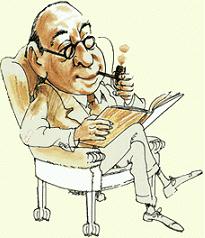
 We owe gratitude to |
Excerpts From the Writings of C.S. Lewis
|
 |

“It is Christ Himself, not the Bible, who is the true word of God. The Bible, read in the right spirit and with the guidance of good teachers, will bring us to Him. C.S. Lewis, God In the Dock, p. 301,
A Note From the Editor -- This is a short observation on Christmas vs. "Exmas", and the current pitiful condition of the season. It draws upon a short essay by C.S. Lewis.
C.S. Lewis wrote (1) a short essay about a "strange land" that observed a very peculiar yearly celebration called "Exmas", and the sending of little pieces of paper called "Exmas Cards", at a tremendous cost in postage, paper and patience. This ritual is preceded by the "Exmas Rush", the object of which seemed to be the selling and buying of VERY much useless and ridiculous foolishness such as no sane person would ever buy for himself or another at any other time of year. This, despite their claims of great poverty and hunger among many of the citizens, and a supposed concern for the depletion of their natural resources !! This "Exmas", it is told, is supposed to be a time of great joy and love, yet the people are so pale and weary and frustrated because of the crowds, the "Rush", and the great expense, that a visitor would be more likely to think that a great calamity had befallen these people. An even stranger fact seemed to be that there was another great celebration during this same period, called "Christmas". This "Christmas" seemed to represent the very opposite of "Exmas", proclaiming a simple time of peace, joy, love, and a forgetting about "The Rush". It revolved around a new born baby and a spiritual story about which I will not now speak. A visitor, upon inquiring of one of their Holy Men about the meaning of these things , was told that yes, "Christmas" and "Exmas" WERE, in fact, a celebration of the same event. However, he wished by the Gods, that "Exmas" would be celebrated at some other time, or better yet - NOT AT ALL !! "Christmas" was to be a time of great joy, happiness and merriment, but in the weariness of "Exmas", there was NO joy, happiness or merriment left. He continued to say that "Exmas" was, in fact, something called, "A Racket". The visitor did not understand this, since to him a racket was something used to play tennis. Read FULL Original by C.S. Lewis - Click Here (1) - C.S. Lewis, God In the Dock, p. 301, Exmas and Christmas
Click HERE for more cartoons !!
[2:32] Does a
young woman forget her jewelry? Does a bride hide her wedding dress?
No! Yet for years on end my people have forgotten
me. C.S. Lewis and J.R. R. Tolkien With all of the renewed interest in the works of C.S. Lewis because of the release of The Chronicles of Narnia, I thought it would be appropriate to offer this insight into the unique relationship between C.S. Lewis and J.R. R. Tolkien. Then, concluding the Communique, I will give you a selection from The Weight of Glory. The book was released in 1949, and is a selection of some of the speeches that he made during his life. One of the chapters in the book bears the title of the book, and is a rather penetrating look into the issue of desire and reward that comes from desire fulfilled. In his typical approach to every issue that he has tackled, he does not take the typical approach that conventional Christian writers will take. He does not massacre the value of desire and he does not minimize the importance of reward. He simply puts it all into a very unique perspective as only Lewis could do. At the time, only one of the men had any kind of reputation: Henry Victor
Dyson, a famous scholar who had shared tables and exchanged words with the likes
of T.E. Lawrence, Virginia Woolf and Bertrand Russell. His two companions were
little-known Oxford academics with a shared taste for Icelandic sagas,
Anglo-Saxon verse and the austere cultural mystique of "the North." Few people
remember Dyson now, while millions celebrate the names of his companions: C.S.
Lewis and .J.R.R. Tolkien. The works that made their reputations -- "The Hobbit" and "The Lord of the
Rings" for Tolkien, "The Chronicles of Narnia" and “The Space Triology” for
Lewis -- were profoundly shaped by that night-long argument and the bond it
cemented. It's possible that Tolkien's Middle-earth would have remained entirely
a private obsession, and quite likely that Lewis would never have found the
gateway to Narnia. Lewis and Tolkien had much in common. Both had been traumatized by the
premature death of their mothers and by the horrors of trench warfare in World
War I. At age 10, Lewis saw his mother dying of cancer. "With my mother's death",
said Lewis, "all that was tranquil and reliable, disappeared from my life." It
is possible that the loss of his mom sat the stage for his entrenched atheism.
Tolkien had experienced the double loss of both his father at age 3 and his
mother at age 12. Tolkien's strong desire for friendship demonstrated in his stories of Frodo,
Sam, Merry & Pippin probably emerged from his loss of his three best friends
in the trenches of World War I. Referring to trench warfare, CS Lewis commented:
"Through the winter, weariness and water were our chief enemies. I have gone to
sleep marching and woken again and found myself marching still." Lewis vividly
remembered "the frights, the cold,...the horribly smashed men still moving like
half-crushed beetles, the sitting or standing corpses, the landscape of sheer
earth without a blade of grass, the boots worn day and night until they seemed
to grow to your feet..." CS Lewis commented: "When I began teaching for the English Faculty, I made
two other friends, both Christians (those queer people seemed to pop up on every
side) who were later to give me much help in getting over the last steps. They
were HVD Dyson and JRR Tolkien. Friendship with the latter marked the breakdown
of two old prejudices..." Lewis once told Tolkien that tales or myths are 'lies and therefore
worthless, even though breathed through silver'. 'No', said Tolkien, 'they are
not lies'. Tolkien went on to explain to Lewis that in Jesus Christ, the ancient
stories or myths of a dying and rising God entered history and became fact.
Twelve days later, Lewis wrote to another friend Arthur Greeves: "I have just
passed on from believing in God to definitely believing in Christ - in
Christianity. I will try to explain this another time. My long night talk with
Dyson and Tolkien had a good deal to do with it". CS Lewis recalls going by
motorcycle with his brother Warren to Whipsnade Zoo, about thirty miles east of
Oxford. "When we set out, I did not believe that Jesus Christ is the Son of God,
and when we reached the zoo, I did". The power of friendship is a notable characteristic of the work and life of
Tolkien. In the Lord of the Rings, this is seen most notably in the friendships
of Frodo and Sam and Frodo and Aragorn. In his life, this is seen in his
friendship with C. S. Lewis. Friendships are gifts, not so much made, but given
to us. Friendship occurs when two people meet who share a common perspective,
experience, insight, treasure, or burden. There is a bond that occurs that
brings them beyond mere acquaintances to friends. And that friendship should be
cherished. There was a natural affinity that developed between Lewis and Tolkien
because of their passion for the pen. Tolkien wrote, “Friendship with Lewis compensates for much, and besides
giving constant pleasure and comfort has done me much good from the contact with
a man at once honest, brave, intellectual - a scholar, a poet, and a philosopher
- and a lover, at least after a long pilgrimage, of Our Lord.” Tolkien saw that
the value of friends was not just that they stand with you, but that they stand
with you and see the same things as you. “Jack soon built up a circle of friends around him who all liked to talk of
the same sorts of things that he did, and so a sort of loose literary society
was formed. It was called “The Inklings.” The Inklings’ meetings were soon held
on Thursday evenings in Jack’s rooms at Magdalen college and on Tuesday
afternoons at one or another of the pubs that abound in Oxford and Headington.”
At these meetings they read aloud and critiqued each other's manuscripts like
‘Tales of Narnia' and 'Lord of the Rings.’ Lewis' brother Warren said that at
the Inklings, "the fun would be riotous with Jack at the top of his form and
enjoying every minute...an outpouring of wit, nonsense, whimsy, dialectical
swordplay, and pungent judgment such as I have rarely heard equaled..." The Inklings group was a clear example of that ancient Proverb "As iron
sharpens iron, so one man sharpens another". In October 1933, Tolkien wrote in
his diary that friendship with Lewis 'besides giving constant pleasure and
comfort, has done me much good from the contact with a man at once honest,
brave, intellectual - a scholar, a poet, and a philosopher - and a lover, at
least after a long pilgrimage, of our Lord'. When Tolkien first shared his 'Lord of the Rings' manuscript at the Inklings
group, CS Lewis said: 'This book is a lightning from a clear sky. Not content to
create his own story, he creates with an almost insolent prodigality the whole
world in which it is to move; with its own theology, myths, geography, history,
paleography, languages and order of beings.' Recent polls have consistently
declared that Tolkien is the most influential author of the last 100 years and
that the Lord of the Rings is the book of the century. Without the Inklings
fellowship of Tolkien and Lewis, neither the Narnia Tales nor the Lord of the
Rings might have ever seen the light of day. Tolkien and Lewis shared the belief that through myth and legend—for
centuries the mode many cultures had used to communicate their deepest truths—a
taste of the Christian gospel's "True Myth" could be smuggled past the barriers
and biases of secularized readers. Early in their relationship, in 1936, after Tolkien had written the
children's story The Hobbit, the two men had a momentous conversation about
their desire to bring such stories to a wider audience (see below, at the end of
this interview, for Duriez's re-creation of that conversation). They actually
decided to divide the territory—Lewis would take "space travel," Tolkien "time
travel." Tolkien never got around to finishing his time-travel story,
concentrating instead on his more "adult" trilogy, in which he placed hobbits in
the context of his Silmarillion stories. But Lewis did write his space trilogy:
Out of the Silent Planet, Perelandra, and That Hideous Strength. What Tolkien did was help Lewis see how the two sides, reason and
imagination, could be integrated. During the two men's night conversations on
the Addison Walk in the grounds of Magdalen College, Tolkien showed Lewis how
the two sides could be reconciled in the Gospel narratives. The Gospels had all
the qualities of great human storytelling. But they portrayed a true event—God
the storyteller entered his own story, in the flesh, and brought a joyous
conclusion from a tragic situation. Suddenly Lewis could see that the
nourishment he had always received from great myths and fantasy stories was a
taste of that greatest, truest story—of the life, death, and resurrection of
Christ. Tolkien was a private man who, when he met Lewis, had written his mythic
tales for a private audience. He had very little confidence that they could
speak to a wider audience. But from the beginning of their relationship, Lewis
encouraged his friend to finish and publish his stories. He delighted to hear
Tolkien read chapters of his epic trilogy at meetings of their Oxford reading
group. Tolkien was immensely encouraged by those times together. He found new
courage and it gave him renewed confidence in his writings. It was a friendship
that was meant to be and the circle of that friendship has blessed all of us. THE WEIGHT OF GLORY
Preached originally as a sermon in the Church of St Mary the Virgin, Oxford, on June 8, 1942: published in THEOLOGY, November, 1941, and by the S.P.C.K, 1942
We must not be troubled by unbelievers when they say that this promise of reward makes the Christian life a mercenary affair. There are different kinds of reward. There is the reward which has no natural connexion with the things you do to earn it, and is quite foreign to the desires that ought to accompany those things. Money is not the natural reward of love; that is why we call a man mercenary if he marries a woman for the sake of her money. But marriage is the proper reward for a real lover, and he is not mercenary for desiring it. A general who fights well in order to get a peerage is mercenary; a general who fights for victory is not, victory being the proper reward of battle as marriage is the proper reward of love. The proper rewards are not simply tacked on to the activity for which they are given, but are the activity itself in consummation. There is also a third case, which is more complicated. An enjoyment of Greek poetry is certainly a proper, and not a mercenary, reward for learning Greek; but only those who have reached the stage of enjoying Greek poetry can tell from their own experience that this is so. The schoolboy beginning Greek grammar cannot look forward to his adult enjoyment of Sophocles as a lover looks forward to marriage or a general to victory. He has to begin by working for marks, or to escape punishment, or to please his parents, or, at best, in the hope of a future good which he cannot at present imagine or desire. His position, therefore, bears a certain resemblance to that of the mercenary; the reward he is going to get will, in actual fact, be a natural or proper reward, but he will not know that till he has got it. Of course, he gets it gradually; enjoyment creeps in upon the mere drudgery, and nobody could point to a day or an hour when the one ceased and the other began. It is just in so far as he approaches the reward that he becomes able to desire it for its own sake; indeed, the power of so desiring it is itself a preliminary reward. The Christian, in relation to heaven, is in much the same position as this schoolboy. Those who have attained everlasting life in the vision of God doubtless know very well that it is no mere bribe, but the very consummation of their earthly discipleship; but we who have not yet attained it cannot know this in the same way, and cannot even begin to know it at all except by continuing to obey and finding the first reward of our obedience in our increasing power to desire the ultimate reward. Just in proportion as the desire grows, our fear lest it should be a mercenary desire will die away and finally be recognized as an absurdity. But probably this will not, for most of us, happen in a day; poetry replaces grammar, gospel replaces law, longing transforms obedience, as gradually as the tide lifts a grounded ship. But there is one other important similarity between the schoolboy and ourselves. If he is an imaginative boy he will, quite probably, be reveling in the English poets and romancers suitable to his age some time before he begins to suspect that Greek grammar is going to lead him to more and more enjoyments of this same sort. He may even be neglecting his Greek to read Shelley and Swinburne in secret. In other words, the desire which Greek is really going to gratify already exists in him and is attached to objects which seem to him quite unconnected with Xenophon and the verbs in mi. Now, if we are made for heaven, the desire for our proper place will be already in us, but not yet attached to the true object, and will even appear as the rival of that object. And this, I think, is just what we find. No doubt there is one point in which my analogy of the schoolboy breaks down. The English poetry which he reads when he ought to be doing Greek exercises may be just as good as the Greek poetry to which the exercises are leading him, so that in fixing on Milton instead of journeying on to Aeschylus his desire is not embracing a false object. But our case is very different. If a transtemporal, transfinite good is our real destiny, then any other good on which our desire fixes must be in some degree fallacious, must bear at best only a symbolical relation to what will truly satisfy. In speaking of this desire for our own far-off country, which we find in ourselves even now, I feel a certain shyness. I am almost committing an indecency. I am trying to rip open the inconsolable secret in each one of you — the secret which hurts so much that you take your revenge on it by calling it names like Nostalgia and Romanticism and Adolescence; the secret also which pierces with such sweetness that when, in very intimate conversation, the mention of it becomes imminent, we grow awkward and affect to laugh at ourselves; the secret we cannot hide and cannot tell, though we desire to do both. We cannot tell it because it is a desire for something that has never actually appeared in our experience. We cannot hide it because our experience is constantly suggesting it, and we betray ourselves like lovers at the mention of a name. Our commonest expedient is to call it beauty and behave as if that had settled the matter. Wordsworth's expedient was to identify it with certain moments in his own past. But all this is a cheat. If Wordsworth had gone back to those moments in the past, he would not have found the thing itself, but only the reminder of it; what he remembered would turn out to be itself a remembering. The books or the music in which we thought the beauty was located will betray us if we trust to them; it was not in them, it only came through them, and what came through them was longing. These things — the beauty, the memory of our own past — are good images of what we really desire; but if they are mistaken for the thing itself they turn into dumb idols, breaking the hearts of their worshippers. For they are not the thing itself; they are only the scent of a flower we have not found, the echo of a tune we have not heard, news from a country we have never yet visited. Do you think I am trying to weave a spell? Perhaps I am; but remember your fairy tales. Spells are used for breaking enchantments as well as for inducing them. And you and I have need of the strongest spell that can be found to wake us from the evil enchantment of worldliness which has been laid upon us for nearly a hundred years. Almost our whole education has been directed to silencing this shy, persistent, inner voice; almost all our modem philosophies have been devised to convince us that the good of man is to be found on this earth. And yet it is a remarkable thing that such philosophies of Progress or Creative Evolution themselves bear reluctant witness to the truth that our real goal is elsewhere. When they want to convince you that earth is your home, notice how they set about it. They begin by trying to persuade you that earth can be made into heaven, thus giving a sop to your sense of exile in earth as it is. Next, they tell you that this fortunate event is still a good way off in the future, thus giving a sop to your knowledge that the fatherland is not here and now. Finally, lest your longing for the transtemporal should awake and spoil the whole affair, they use any rhetoric that comes to hand to keep out of your mind the recollection that even if all the happiness they promised could come to man on earth, yet still each generation would lose it by death, including the last generation of all, and the whole story would be nothing, not even a story, for ever and ever. Hence all the nonsense that Mr. Shaw puts into the final speech of Lilith, and Bergson's remark that the élan vital is capable of surmounting all obstacles, perhaps even death — as if we could believe that any social or biological development on this planet will delay the senility of the sun or reverse the second law of thermodynamics. Do what they will, then, we remain conscious of a desire which no natural happiness will satisfy. But is there any reason to suppose that reality offers any satisfaction to it? "Nor does the being hungry prove that we have bread." But I think it may be urged that this misses the point. A man's physical hunger does not prove that that man will get any bread; he may die of starvation on a raft in the Atlantic. But surely a man's hunger does prove that he comes of a race which repairs its body by eating and inhabits a world where eatable substances exist. In the same way, though I do not believe (I wish I did) that my desire for Paradise proves that I shall enjoy it, I think it a pretty good indication that such a thing exists and that some men will. A man may love a woman and not win her; but it would be very odd if the phenomenon called "falling in love" occurred in a sexless world. Here, then, is the desire, still wandering and uncertain of its object and still largely unable to see that object in the direction where it really lies. Our sacred books give us some account of the object. It is, of course, a symbolical account. Heaven is, by definition, outside our experience, but all intelligible descriptions must be of things within our experience. The scriptural picture of heaven is therefore just as symbolical as the picture which our desire, unaided, invents for itself; heaven is not really full of jewelry any more than it is really the beauty of Nature, or a fine piece of music. The difference is that the scriptural imagery has authority. It comes to us from writers who were closer to God than we, and it has stood the test of Christian experience down the centuries. The natural appeal of this authoritative imagery is to me, at first, very small. At first sight it chills, rather than awakes, my desire. And that is just what I ought to expect. If Christianity could tell me no more of the far-off land than my own temperament led me to surmise already, then Christianity would be no higher than myself. If it has more to give me, I must expect it to be less immediately attractive than "my own stuff." Sophocles at first seems dull and cold to the boy who has only reached Shelley. If our religion is something objective, then we must never avert our eyes from those elements in it which seem puzzling or repellent; for it will be precisely the puzzling or the repellent which conceals what we do not yet know and need to know. The promises of Scripture may very roughly be reduced to five heads. It is promised, firstly, that we shall be with Christ; secondly, that we shall be like Him; thirdly, with an enormous wealth of imagery, that we shall have "glory"; fourthly, that we shall, in some sense, be fed or feasted or entertained; and, finally, that we shall have some sort of official position in the universe — ruling cities, judging angels, being pillars of God's temple. The first question I ask about these promises is: "Why any of them except the first?" Can anything be added to the conception of being with Christ? For it must be true, as an old writer says, that he who has God and everything else has no more than he who has God only. I think the answer turns again on the nature of symbols. For though it may escape our notice at first glance, yet it is true that any conception of being with Christ which most of us can now form will be not very much less symbolical than the other promises; for it will smuggle in ideas of proximity in space and loving conversation as we now understand conversation, and it will probably concentrate on the humanity of Christ to the exclusion of His deity. And, in fact, we find that those Christians who attend solely to this first promise always do fill it up with very earthly imagery indeed — in fact, with hymeneal or erotic imagery. I am not for a moment condemning such imagery. I heartily wish I could enter into it more deeply than I do, and pray that I yet shall. But my point is that this also is only a symbol, like the reality in some respects, but unlike it in others, and therefore needs correction from the different symbols in the other promises. The variation of the promises does not mean that anything other than God will be our ultimate bliss; but because God is more than a Person, and lest we should imagine the joy of His presence too exclusively in terms of our present poor experience of personal love, with all its narrowness and strain and monotony, a dozen changing images, correcting and relieving each other, are supplied. I turn next to the idea of glory. There is no getting away from the fact that this idea is very prominent in the New Testament and in early Christian writings. Salvation is constantly associated with palms, crowns, white robes, thrones, and splendor like the sun and stars. All this makes no immediate appeal to me at all, and in that respect I fancy I am a typical modern. Glory suggests two ideas to me, of which one seems wicked and the other ridiculous. Either glory means to me fame, or it means luminosity. As for the first, since to be famous means to be better known than other people, the desire for fame appears to me as a competitive passion and therefore of hell rather than heaven. As for the second, who wishes to become a kind of living electric light bulb? When I began to look into this matter I was shocked to find such different Christians as Milton, Johnson and Thomas Aquinas taking heavenly glory quite frankly in the sense of fame or good report. But not fame conferred by our fellow creatures — fame with God, approval or (I might say) "appreciation' by God. And then, when I had thought it over, I saw that this view was scriptural; nothing can eliminate from the parable the divine accolade, "Well done, you good and faithful servant." With that, a good deal of what I had been thinking all my life fell down like a house of cards. I suddenly remembered that no one can enter heaven except as a child; and nothing is so obvious in a child — not in a conceited child, but in a good child — as its great and undisguised pleasure in being praised. Not only in a child, either, but even in a dog or a horse. Apparently what I had mistaken for humility had, all these years, prevented me from understanding what is in fact the humblest, the most childlike, the most creaturely of pleasures — nay, the specific pleasure of the inferior: the pleasure a beast before men, a child before its father, a pupil before his teacher, a creature before its Creator. I am not forgetting how horribly this most innocent desire is parodied in our human ambitions, or how very quickly, in my own experience, the lawful pleasure of praise from those whom it was my duty to please turns into the deadly poison of self-admiration. But I thought I could detect a moment — a very, very short moment — before this happened, during which the satisfaction of having pleased those whom I rightly loved and rightly feared was pure. And that is enough to raise our thoughts to what may happen when the redeemed soul, beyond all hope and nearly beyond belief, learns at last that she has pleased Him whom she was created to please. There will be no room for vanity then. She will be free from the miserable illusion that it is her doing. With no taint of what we should now call self-approval she will most innocently rejoice in the thing that God has made her to be, and the moment which heals her old inferiority complex for ever will also drown her pride deeper than Prospero's book. Perfect humility dispenses with modesty. If God is satisfied with the work, the work may be satisfied with itself; "it is not for her to bandy compliments with her Sovereign." I can imagine someone saying that he dislikes my idea of heaven as a place where we are patted on the back. But proud misunderstanding is behind that dislike. In the end that Face which is the delight or the terror of the universe must be turned upon each of us either with one expression or with the other, either conferring glory inexpressible or inflicting shame that can never be cured or disguised. I read in a periodical the other day that the fundamental thing is how we think of God. By God Himself, it is not! How God thinks of us is not only more important, but infinitely more important. Indeed, how we think of Him is of no importance except in so far as it is related to how He thinks of us. It is written that we shall "stand before" Him, shall appear, shall be inspected. The promise of glory is the promise, almost incredible and only possible by the work of Christ, that some of us, that any of us who really chooses, shall actually survive that examination, shall find approval, shall please God. To please God -- to be a real ingredient in the divine happiness -- to be loved by God, not merely pitied, but delighted in as an artist delights in his work or a father in a son — it seems impossible, a weight or burden of glory which our thoughts can hardly sustain. But so it is. And now notice what is happening. If I had rejected the authoritative and scriptural image of glory and stuck obstinately to the vague desire which was, at the outset, my only pointer to heaven, I could have seen no connexion at all between that desire and the Christian promise. But now, having followed up what seemed puzzling and repellent in the sacred books, I find, to my great surprise, looking back, that the connexion is perfectly clear. Glory, as Christianity teaches me to hope for it, turns out to satisfy my original desire and indeed to reveal an element in that desire which I had not noticed. By ceasing for a moment to consider my own wants I have begun to learn better what I really wanted. When I attempted, a few minutes ago, to describe our spiritual longings, I was omitting one of their most curious characteristics. We usually notice it just as the moment of vision dies away, as the music ends or as the landscape loses the celestial light. What we feel then has been well described by Keats as "the journey homeward to habitual self." You know what I mean. For a few minutes we have had the illusion of belonging to that world. Now we wake to find that it is no such thing. We have been mere spectators. Beauty has smiled, but not to welcome us; her face was turned in our direction, but not to see us. We have not been accepted, welcomed, or taken into the dance. We may go when we please, we may stay if we can: "Nobody marks us." A scientist may reply that since most of the things we call beautiful are inanimate, it is not very surprising that they take no notice of us. That, of course, is true. It is not the physical objects that I am speaking of, but that indescribable something of which they become for a moment the messengers. And part of the bitterness which mixes with the sweetness of that message is due to the fact that it so seldom seems to be a message intended for us but rather something we have overheard. By bitterness I mean pain, not resentment. We should hardly dare to ask that any notice be taken of ourselves. But we pine. The sense that in this universe we are treated as strangers, the longing to be acknowledged, to meet with some response, to bridge some chasm that yawns between us and reality, is part of our inconsolable secret. And surely, from this point of view, the promise of glory, in the sense described, becomes highly relevant to our deep desire. For glory meant good report with God, acceptance by God, response, acknowledgment, and welcome into the heart of things. The door on which we have been knocking all our lives will open at last. Perhaps it seems rather crude to describe glory as the fact of being "noticed" by God. But this is almost the language of the New Testament. St. Paul promises to those who love God not, as we should expect, that they will know Him, but that they will be known by Him (I Cor. viii. 3). It is a strange promise. Does not God know all things at all times? But it is dreadfully reechoed in another passage of the New Testament. There we are warned that it may happen to any one of us to appear at last before the face of God and hear only the appalling words, "I never knew you. Depart from Me." In some sense, as dark to the intellect as it is unendurable to the feelings, we can be both banished from the presence of Him who is present everywhere and erased from the knowledge of Him who knows all. We can be left utterly and absolutely outside — repelled, exiled, estranged, finally and unspeakably ignored. On the other hand, we can be called in, welcomed, received, acknowledged. We walk every day on the razor edge between these two incredible possibilities. Apparently, then, our lifelong nostalgia, our longing to be reunited with something in the universe from which we now feel cut off, to be on the inside of some door which we have always seen from the outside, is no mere neurotic fancy, but the truest index of our real situation. And to be at last summoned inside would be both glory and honor beyond all our merits and also the healing of that old ache. And this brings me to the other sense of glory — glory as brightness, splendor, luminosity. We are to shine as the sun, we are to be given the Morning Star. I think I begin to see what it means. In one way, of course, God has given us the Morning Star already: you can go and enjoy the gift on many fine mornings if you get up early enough. What more, you may ask, do we want? Ah, but we want so much more — something the books on aesthetics take little notice of. But the poets and the mythologies know all about it. We do not want merely to see beauty, though, God knows, even that is bounty enough. We want something else which can hardly be put into words — to be united with the beauty we see, to pass into it, to receive it into ourselves, to bathe in it, to become part of it. That is why we have peopled air and earth and water with gods and goddesses and nymphs and elves — that, though we cannot, yet these projections can enjoy within themselves that beauty grace, and power of which Nature is the image. That is why the poets tell us such lovely falsehoods. They talk as if the west wind could really sweep into a human soul; but it can't. They tell us that "beauty born of murmuring sound" will pass into a human face; but it won't. Or not yet. For if we take the imagery of Scripture seriously, if we believe that God will one day give us the Morning Star and cause us to put on the splendor of the sun, then we may surmise that both the ancient myths and the modern poetry, so false as history, may be very near the truth as prophecy. At present we are on the outside of the world, the wrong side of the door. We discern the freshness and purity of morning, but they do not make us fresh and pure. We cannot mingle with the splendors we see. But all the leaves of the New Testament are rustling with the rumor that it will not always be so. Some day, God willing, we shall get in. When human souls have become as perfect in voluntary obedience as the inanimate creation is in its lifeless obedience, then they will put on its glory, or rather that greater glory of which Nature is only the first sketch. For you must not think that I am putting forward any heathen fancy of being absorbed into Nature. Nature is mortal; we shall outlive her. When all the suns and nebulae have passed away, each one of you will still be alive. Nature is only the image, the symbol; but it is the symbol Scripture invites me to use. We are summoned to pass in through Nature, beyond her, into that splendor which she fitfully reflects. In there, in beyond Nature, we shall eat of the tree of life. At present, if we are reborn in Christ, the spirit in us lives directly on God; but the mind, and still more the body, receives life from Him at a thousand removes — through our ancestors, through our food, through the elements. The faint, far-off results of those energies which God's creative rapture implanted in matter when He made the worlds are what we now call physical pleasures; and even thus filtered, they are too much for our present management. What would it be to taste at the fountainhead that stream of which even these lower reaches prove so intoxicating? Yet that, I believe, is what lies before us. The whole man is to drink joy from the fountain of joy. As St. Augustine said, the rapture of the saved soul will "flow over" into the glorified body. In the light of our present specialized and depraved appetites we cannot imagine this torrens voluptatis, and I warn everyone seriously not to try. But it must be mentioned, to drive out thoughts even more misleading — thoughts that what is saved is a mere ghost, or that the risen body lives in numb insensibility. The body was made for the Lord, and these dismal fancies are wide of the mark. Meanwhile the cross comes before the crown and tomorrow is a Monday morning. A cleft has opened in the pitiless walls of the world, and we are invited to follow our great Captain inside. The following Him is, of course, the essential point. That being so, it may be asked what practical use there is in the speculations which I have been indulging. I can think of at least one such use. It may be possible for each to think too much of his own potential glory hereafter; it is hardly possible for him to think too often or too deeply about that of his neighbor. The load, or weight, or burden of my neighbor's glory should be laid daily on my back, a load so heavy that only humility can carry it, and the backs of the proud will be broken. It is a serious thing to live in a society of possible gods and goddesses, to remember that the dullest and most uninteresting person you talk to may one day be a creature which, if you saw it now, you would be strongly tempted to worship, or else a horror and a corruption such as you now meet, if at all, only in a nightmare. All day long we are, in some degree, helping each other to one or other of these destinations. It is in the light of these overwhelming possibilities, it is with the awe and the circumspection proper to them, that we should conduct all our dealings with one another, all friendships, all loves, all play, all politics. There are no ordinary people. You have never talked to a mere mortal. Nations, cultures, arts, civilization — these are mortal, and their life is to ours as the life of a gnat. But it is immortals whom we joke with, work with, marry, snub, and exploit — immortal horrors or everlasting splendors. This does not mean that we are to be perpetually solemn. We must play. But our merriment must be of that kind (and it is, in fact, the merriest kind) which exists between people who have, from the outset, taken each other seriously — no flippancy, no superiority, no presumption. And our charity must be a real and costly love, with deep feeling for the sins in spite of which we love the sinner — no mere tolerance or indulgence which parodies love as flippancy parodies merriment. Next to the Blessed Sacrament itself, your neighbor is the holiest object presented to your senses. If he is your Christian neighbor he is holy in almost the same way, for in him also Christ vere latitat — the glorifier and the glorified, Glory Himself, is truly hidden.
The Screwtape Letters -- Chapter Fifteen
By C.S. Lewis
My aim is to know him, to experience the power of his resurrection, to share in his sufferings, and to be like him in his death, and so, somehow, to attain to the resurrection from the dead. Not that I have already attained this -- that is, I have not already been perfected -- but I strive to lay hold of that for which Christ Jesus also laid hold of me. Brothers and sisters, I do not consider myself to have attained this. Instead, I am single-minded: Forgetting the things that are behind and reaching out for the things that are ahead, with this goal in mind, I strive toward the prize of the upward call of God in Christ Jesus. ** Phil 3:10-14 This is an imaginary conversation between two demons (a Master and his disciple), discussing how to best ensnare their human subject. "The Enemy" is a reference to God or Jesus Christ) The humans live in time but our Enemy destines them to eternity. He therefore, I believe, wants them to attend chiefly to two things, to eternity itself, and to that point of time which they call the Present. For the Present is the point at which time touches eternity. Of the present moment, and of it only, humans have an experience analogous to the experience which our Enemy has of reality as a whole; in it alone freedom and actuality are offered them. He would therefore have them continually concerned either with eternity (which means being concerned with Him) or with the Present — either meditating on their eternal union with, or separation from, Himself, or else obeying the present voice of conscience, bearing the present cross, receiving the present grace, giving thanks for the present pleasure. Our business is to get them away from the eternal, and from the Present. With this in view, we sometimes tempt a human (say a widow or a scholar) to live in the Past. But this is of limited value, for they have some real knowledge of the past and it has a determinate nature and, to that extent, resembles eternity. It is far better to make them live in the Future. Biological necessity makes all their passions point in that direction already, so that thought about the Future inflames hope and fear. Also, it is unknown to them, so that in making them think about it we make them think of unrealities. In a word, the Future is, of all things, the thing least like eternity. It is the most completely temporal part of time — for the Past is frozen and no longer flows, and the Present is all lit up with eternal rays. Hence the encouragement we have given to all those schemes of thought such as Creative Evolution, Scientific Humanism, or Communism, which fix men's affections on the Future, on the very core of temporality. Hence nearly all vices are rooted in the future. Gratitude looks to the past and love to the present; fear, avarice, lust, and ambition look ahead. Do not think lust an exception. When the present pleasure arrives, the sin (which alone interests us) is already over. The pleasure is just the part of the process which we regret and would exclude if we could do so without losing the sin; it is the part contributed by the Enemy, and therefore experienced in a Present. The sin, which is our contribution, looked forward. To be sure, the Enemy wants men to think of the Future too -- just so much as is necessary for now planning the acts of justice or charity which will probably be their duty tomorrow. The duty of planning the morrow's work is today's duty; though its material is borrowed from the future, the duty, like all duties, is in the Present. This is not straw splitting. He does not want men to give the Future their hearts, to place their treasure in it. We do. His ideal is a man who, having worked all day for the good of posterity (if that is his vocation), washes his mind of the whole subject, commits the issue to Heaven, and returns at once to the patience or gratitude demanded by the moment that is passing over him. But we want a man hag-ridden by the Future — haunted by visions of an imminent heaven or hell upon earth — ready to break the Enemy's commands in the present if by so doing we make him think he can attain the one or avert the other — dependent for his faith on the success or failure of schemes whose end he will not live to see. We want a whole race perpetually in pursuit of the rainbow's end, never honest, nor kind, nor happy now, but always using as mere fuel wherewith to heap the altar of the future every real gift which is offered them in the Present. It follows then, in general, and others things being equal, that it is better for your patient to be filled with anxiety or hope (it doesn't much matter which) about this war than for him to be living in the present. But the phrase "living in the present" is ambiguous. It may describe a process which is really just as much concerned with the Future as anxiety itself. Your man may be untroubled about the Future, not because he is concerned with the Present, but because he has persuaded himself that the Future is going to be agreeable. As long as that is the real course of his tranquillity, his tranquillity will do us good, because it is only piling up more disappointment, and therefore more impatience, for him when his false hopes are dashed. If, on the other hand, he is aware that horrors may be in store for him and is praying for the virtues, wherewith to meet them, and meanwhile concerning himself with the Present because there, and there alone, all duty, all grace, all knowledge, and all pleasure dwell, his state is very undesirable and should be attacked at once. Here again, our Philological Arm has done good work; try the word "complacency" on him. But, of course, it is most likely that he is "living in the Present" for none of these reasons but simply because his health is good and he is enjoying his work. The phenomenon would then be merely natural.
Miracles -- Chapter Six -- "Answers to Misgivings"
By C.S. Lewis
That brings me to the second consideration. The state of affairs in which ordinary people can discover the Supernatural only by abstruse reasoning is recent and, by historical standards, abnormal. All over the world, until quite modern times, the direct insight of the mystics and the reasonings of the philosophers percolated to the mass of the people by authority and tradition; they could be received by those who were no great reasoners themselves in the concrete form of myth and ritual and the whole pattern of life. In the conditions produced by a century or so of Naturalism, plain men are being forced to bear burdens which plain men were never expected to bear before. We must get the truth for ourselves or go without it. There may be two explanations for this. It might be that humanity, in rebelling against tradition and authority, has made a ghastly mistake; a mistake which will not be the less fatal because the corruption of those in authority rendered it very excusable. On the other hand, it may be that the Power which rules our species is at this moment carrying out a daring experiment. Could it be intended that the whole mass of the people should now move forward and occupy for themselves those heights which were once reserved only for the sages? Is the distinction between wise and simple to disappear because all are now expected to become wise? if so, our present blundering would be but growing pains. But let us make no mistake about our necessities. if we are content to go back and become humble plain men obeying a tradition, well. if we are ready to climb and struggle on till we become sages ourselves, better still. However, the man who will neither obey wisdom in others nor adventure for her/himself is fatal. A society where the simple many obey the few seers can live: a society where all were seers could live even more fully. But a society where the mass is still simple and the seers are no longer attended to can achieve only superficiality, baseness, ugliness, and in the end -- extinction. On or back we must go; to stay here is death. A Note From the Editor -- This writing by C.S. Lewis is HIGHLY recommended for anyone seeking to understand the fundamentals of God and Christianity from a rational and intelligent perspective. Lewis was a prime force in lighting my way to the acceptance of Jesus Christ as my Lord and Savior. The book, "Mere Christianity", is actually comprised of two books: "The Case for Christianity" and "Christian Behavior". The name, "MERE Christianity" was chosen, not to denig the faith, but as a reference to what he was writing about, the Christian Faith stripped of its sectarian and denominational baggage, reduced to its "bare fundamentals". Two other of his books, well worth reading and HIGHLY recommended, are: "The Great Divorce" and "The Screwtape Letters". I wish you profitable and enlightening reading !!
Mere Christianity -- Chapter One -- "The Three Parts of Morality"
By C.S. Lewis
Now let us go a step further. There are two ways in which the human machine goes wrong. One is when human individuals drift apart from one another, or else collide with one another and do one another damage, by cheating or bullying. The other is when things go wrong inside the individual — when the different parts of him (his different faculties and desires and so on) either drift apart or interfere with one another. You can get the idea plain if you think of us as a fleet of ships sailing in formation. The voyage will be a success only, in the first place, if the ships do not collide and get in one another's way; and, secondly, if each ship is seaworthy and has her engines in good order. As a matter of fact, you cannot have either of these two things without the other. if the ships keep on having collisions they will not remain seaworthy very long. On the other hand, if their steering gears are out of order they will not be able to avoid collisions. Or, if you like, think of humanity as a band playing a tune. To get a good result, you need two things. Each player's individual instrument must be in tune and also each must come in at the right moment so as to combine with all the others. There is one thing we have not yet taken into account. We have not asked where the fleet is trying to get to, or what piece of music the band is trying to play. The instruments might be all in tune and might all come in at the right moment, but even so the performance would not be a success if they had been engaged to provide dance music and actually played nothing but Dead Marches. And however well the fleet sailed, its voyage would be a failure if it were meant to reach New York and actually arrived at Calcutta. Morality, then, seems to be concerned with three things. Firstly, with fair play and harmony between individuals. Secondly, with what might be called tidying up or harmonizing the things inside each individual. Thirdly, with the general purpose of human life as a whole: what man was made for: what course the whole fleet ought to be on: what tune the conductor of the band wants it to play. You may have noticed that modern people are nearly always thinking about the first thing and forgetting the other two. When people say in the newspapers that we are striving for Christian moral standards, they usually mean that we are striving for kindness and fair play between nations, and classes, and individuals; that is, they are thinking only of the first thing. When a man says about something he wants to do, "It can't be wrong because it doesn't do anyone else any harm," he is thinking only of the first thing. He is thinking it does not matter what his ship is like inside provided that he does not run into the next ship. And it is quite natural, when we start thinking about morality, to begin with the first thing, with social relations. For one thing, the results of bad morality in that sphere is so obvious and press on us every day: war and poverty and graft and lies and shoddy work. And also, as long as you stick to the first thing, there is very little disagreement about morality. Almost all people at all times have agreed (in theory) that human beings ought to be honest and kind and helpful to one another. But though it is natural to begin with all that, if our thinking about morality stops there, we might just as well not have thought at all. Unless we go on to the second thing — the tidying up inside each human being — we are only deceiving ourselves. What is the good of telling the ships how to steer so as to avoid collisions if, in fact, they are such crazy old tubs that they cannot be steered at all? What is the good of drawing up, on paper, rules for social behavior, if we know that, in fact, our greed, cowardice, ill temper, and self-conceit are going to prevent us from keeping them? I do not mean for a moment that we ought not to think, and think hard, about improvements in our social and economic system. What I do mean is that all that thinking will be mere moonshine unless we realize that nothing but the courage and unselfishness of individuals is ever going to make any system work properly. It is easy enough to remove the particular kinds of graft or bullying that go on under the present system: but as long as men are twisters or bullies they will find some new way of carrying on the old game under the new system. You cannot make men good by law: and without good men you cannot have a good society. That is why we must go on to think of the second thing: of morality inside the individual. I do not, however, think we can stop there either. We are now getting to the point at which different beliefs about the universe lead to different behavior. It would seem, at first sight, very sensible to stop before we got there, and just carry on with those parts of morality that all sensible people agree about. But can we? Remember that religion involves a series of statements about facts, which must be either true or false. If they are true, one set of conclusions will follow about the right sailing of the human fleet: if they are false, quite a different set. For example, let us go back to the man who says that a thing cannot be wrong unless it hurts some other human being. He quite understands that he must not damage the other ships in the convoy, but he honestly thinks that what he does to his own ship is simply his own business. However, does it not make a great difference whether his ship is his own property or not? Does it not make a great difference whether I am, so to speak, the landlord of my own mind and body, or only a tenant, responsible to the real landlord? If somebody else made me, for his own purposes, then I shall have a lot of duties which I should not have if I simply belonged to myself. Again, Christianity asserts that every individual human being is going to live for ever, and this must be either true or false. Now there are a good many things which would not be worth bothering about if I were going to live only seventy years, but which I had better bother about very seriously if I am going to live for ever. Perhaps my bad temper or my jealousy are gradually getting worse — so gradually that the increase in seventy years will not be very noticeable. But it might be absolute hell in a million years: in fact, if Christianity is true, Hell is the precisely correct technical term for what it would be. And immortality makes this other difference, which, by the by, has a connection with the difference between totalitarianism and democracy. If individuals live only seventy years, then a state, or a nation, or a civilization, which may last for a thousand years, is more important than an individual. But if Christianity is true, then the individual is not only more important but incomparably more important, for he is everlasting and the life of a state or a civilization, compared with his, is only a moment. It seems, then, that if we are to think about morality, we must think of all three departments: relations between man and man: things inside each man: and relations between man and the power that made him. We can all cooperate in the first one. Disagreements begin with the second and become more serious with the third. It is dealing with the third that the main differences between Christian and non-Christian morality come out.
Chapter 23, 24, 26-33 of "Mere Christianity"
CHAPTER 23 -- MAKING AND BEGETTING
In a way I quite understand why some people are put off by Theology. I remember once when I had been giving a talk to the R.A.F., an old, hard-bitten officer got up and said, `I've no use for all that stuff. But, mind you, I'm a religious man too. I know there's a God. I've felt Him out alone in the desert at night: the tremendous mystery. And that's just why I don't believe all your neat little dogmas and formulas about Him. To anyone who's met the real thing they all seem so petty and pedantic and unreal !' Now in a sense I quite agreed with that man. I think he had probably had a real experience of God in the desert. And when he turned from that experience to the Christian creeds, I think he really was turning from something real to something less real. In the same way, if a man has once looked at the Atlantic from the beach, and then goes and looks at a map of the Atlantic, he also will be turning from something real to something less real: turning from real waves to a bit of coloured paper. But here comes the point. The map is admittedly only coloured paper, but there are two things you have to remember about it. In the first place, it is based on what hundreds and thousands of people have found out by sailing the real Atlantic. In that way it has behind it masses of experience just as real as the one you could have from the beach; only, while yours would be a single glimpse, the map fits all those different experiences together. In the second place, if you want to go anywhere, the map is absolutely necessary. As long as you are content with walks on the beach, your own glimpses are far more fun than looking at a map. But the map is going to be more use than walks on the beach if you want to get to America. Now, Theology is like the map. Merely learning and thinking about the Christian doctrines, if you stop there, is less real and less exciting than the sort of thing my friend got in the desert. Doctrines are not God: they are only a kind of map. But that map is based on the experience of hundreds of people who really were in touch with God-experiences compared with which any thrills or pious feelings you and I are likely to get on our own are very elementary and very confused. And secondly, if you want to get any further, you must use the map. You see, what happened to that man in the desert may have been real, and was certainly exciting, but nothing comes of it. It leads nowhere. There is nothing to do about it. In fact, that is just why a vague religion-all about feeling God in nature, and so on-is so attractive. It is all thrills and no work; like watching the waves from the beach. But you will not get to Newfoundland by studying the Atlantic that way, and you will not get eternal life by simply feeling the presence of God in flowers or music. Neither will you get anywhere by looking at maps without going to sea. Nor will you be very safe if you go to sea without a map. In other words, Theology is practical: especially now. In the old days, when there was less education and discussion, perhaps it was possible to get on with a very few simple ideas about God. But it is not so now. Everyone reads, everyone hears things discussed. Consequently, if you do not listen to Theology, that will not mean that you have no ideas about God. It will mean that you have a lot of wrong ones - bad, muddled, out-of-date ideas. For a great many of the ideas about God which are trotted out as novelties to-day are simply the ones which real Theologians tried centuries ago and rejected. To believe in the popular religion of modern England is retrogression - like believing the earth is flat. For when you get down to it, is not the popular idea of Christianity simply this: that Jesus Christ was a great moral teacher and that if only we took His advice we might be able to establish a better social order and avoid another war? Now, mind you, that is quite true. But it tells you much less than the whole truth about Christianity and it has no practical importance at all. It is quite true that if we took Christ's advice we should soon be living in a happier world. You need not even go as far as Christ. If we did all that Plato or Aristotle or Confucius told us, we should get on a great deal better than we do. And so what: We never have followed the advice of the great teachers. Why are we likely to begin now? Why are we more likely to follow Christ than any of the others? Because He is the best moral teacher? But that makes it even less likely that we shall follow Him. If we cannot take the elementary lessons, is it likely we are going to take the most advanced one? If Christianity only means one more bit of good advice, then Christianity is of no importance. There has been no lack of good advice for the last four thousand years. A bit more makes no difference. As soon as you look at any real Christian writings, you find that they are talking about something quite different from this popular religion. They say that Christ is the Son of God (whatever that means). They say that those who give Him their confidence can also become Sons of God (whatever that means). They say that His death saved us from our sins (whatever that means). There is no good complaining that these statements are difficult. Christianity claims to be telling us about another world, about something behind the world we can touch and hear and see. You may think the claim false; but if it were true, what it tells us would be bound to be difficult-at least as difficult as modern Physics, and for the same reason. Now the point in Christianity which gives us the greatest shock is the statement that by attaching ourselves to Christ, we can `become Sons of God'. One asks `Aren't we Sons of God already? Surely the fatherhood of God is one of the main Christian ideas?' Well, in a certain sense, no doubt we are sons of God already. I mean, God has brought us into existence and loves us and looks after us, and in that way is like a father. But when the Bible talks of our `becoming' Sons of God, obviously it must mean something different. And that brings us up against the very centre of Theology. One of the creeds says that Christ is the Son of God 'begotten, not created'; and it adds `begotten by his Father before all worlds'. Will you please get it quite clear that this has .nothing to do with the fact that when Christ was born on earth as a man, that man was the son of a virgin? We are not now thinking about the Virgin Birth. We are thinking about something that happened before Nature was created at all, before time began. `Before all worlds' Christ is begotten, not created. What does it mean? We don't use the words begetting or begotten much in modern English, but everyone still knows what they mean. To beget is to become the father of: to create is to make. And the difference is this. When you beget, you beget something of the same kind as yourself. A man begets human babies, a beaver begets little beavers and a bird begets eggs which turn into little birds. But when you make, you make something of a different kind from yourself. A bird makes a nest, a beaver builds a dam, a man makes a wireless set-or he may make something more like himself than a wireless set : say, a statue. If he is a clever enough carver he may make a statue which is very like a man indeed. But, of course, it is not a real man; it only looks like one. It cannot breathe or think. It is not alive. Now that is the first thing to get clear. What God begets is God; just as what man begets is man. What God creates is not God; just as what man makes is not man. That is why men are not Sons of God in the sense that Christ is. They may be like God in certain ways, but they are not things of the same kind. They are more like statues or pictures of God. A statue has the shape of a man but is not alive. In the same way, man has (in a sense I am going to explain) the `shape' or likeness of God, but he has not got the kind of life God has. Let us take the first point (man's resemblance to God) first. Everything God has made has some likeness to Himself. Space is like Him in its hugeness: not that the greatness of space is the same kind of greatness as God's, but it is a sort of symbol of it, or a translation of it into non-spiritual terms. Matter is like God in having energy: though, again, of course, physical energy is a different kind of thing from the power of God. The vegetable world is like Him because it is alive, and He is the 'living God'. But life, in this biological sense, is not the same as the life there is in God: it is only a kind of symbol or shadow of it. When we come on to the animals, we find other kinds of resemblance in addition to biological life. The intense activity and fertility of the insects, for example, is a first dim resemblance to the unceasing activity and the creativeness of God. In the higher mammals we get the beginnings of instinctive affection. That is not the same thing as the love that exists in God: but it is like it - rather in the way that a picture drawn on a flat piece of paper can nevertheless be `like' a landscape. When we come to man, the highest of the animals, we get the completest resemblance to God which we know of. (There may be creatures in other worlds who are more like God than man is, but we do not know about them.) Man not only lives, but loves and reasons: biological life reaches its highest known level in him. What man, in his natural condition, has not got, is Spiritual life the higher and different sort of life that exists in God. We use the same word life for both: but if you thought that both must therefore be the same sort of thing, that would be like thinking that the 'greatness' of space and the `greatness' of God were the same sort of greatness. In reality, the difference between Biological life and Spiritual life is so important that I am going to give them two distinct names. The Biological sort which comes to us through Nature, and which (like everything else in Nature) is always tending to run down and decay so that it can only be kept up by incessant subsidies from Nature in the form of air, water, food, etc., is Bios. The Spiritual life which is in God from all eternity, and which made the whole natural universe, is Zoe. Bios has, to be sure, a certain shadowy or symbolic resemblance to Zoe: but only the sort of resemblance there is between a photo and a place, or a statue and a man. A man who changed from having Bios to having Zoe would have gone through as big a change as a statue which changed from being a carved stone to being a real man. That is precisely what Christianity is about. This world is a great sculptor's shop. We are the statues and there is a rumour going round the shop that some of us are some day going to come to life. CHAPTER 24 -- THE THREE-PERSONAL GOD The last chapter was about the difference between begetting and making. A man begets a child, but he only makes a statue. God begets Christ but He only makes men. But by saying that, I have illustrated only one point about God, namely, that what God the Father begets is God, something of the same kind as Himself. In that way it is like a human father begetting a human son. But not quite like it. So I must try to explain a little more. A good many people nowadays say, `I believe in a God, but not in a personal God.' They feel that the mysterious something which is behind all other things must be more than a person. Now the Christians quite agree. But the Christians are the only people who offer any idea of what a being that is beyond personality could be like. All the other people, though they say that God is beyond personality, really think of Him as something impersonal: that is, as something less than personal. If you are looking for something super-personal, something more than a person, then it is not a question of choosing between the Christian idea and the other ideas. The Christian idea is the only one on the market. Again, some people think that after this life, or perhaps after several lives, human souls will be 'absorbed' into God. But when they try to explain what they mean, they seem to be thinking of our being absorbed into God as one material thing is absorbed into another. They say it is like a drop of water slipping into the sea. But of course that is the end of the drop. If that is what happens to us, then being absorbed is the same as ceasing to exist. It is only the Christians who have any idea of how human souls can be taken into the life of God and yet remain themselves-in face, be very much more themselves than they were before. I warned you that Theology is practical. The whole purpose for which we exist is to be thus taken into the life of God. Wrong ideas about what that life is will make it harder. And now, for a few minutes, I must ask you to follow rather carefully. You know that in space you can move in three ways - to left or right, backwards or forwards, up or down. Every direction is either one of these three or a compromise between them. They are called the three Dimensions. Now notice :his. If you are using only one dimension, you could draw only a straight line. If you are using two; you could draw a figure: say, a square. And a square is made up of four straight lines. Now a step further. If you have three dimensions, you can then build what we call a solid body: say, a cube - a thing like a dice or a lump of sugar. And a cube is made up of six squares. Do you see the point? A world of one dimension would be a straight line. In a two-dimensional world, you still get straight lines, but many lines make one figure. In a three-dimensional world, you still get figures but many figures make one solid body. In other words, as you advance to more real and more complicated levels, you do not leave behind you the things you found on the simpler levels: you still have them, but combined in new ways - in ways you could not imagine if you knew only the simpler levels. Now the Christian account of God involves just the same principle. The human level is a simple and rather empty level. On the human level one person is one being, and any two persons are two separate beings - just as, in two dimensions (say on a flat sheet of paper) one square is one figure, and any two squares are two separate figures. On the Divine level you still find personalities; but up there you find them combined in new ways which we, who do not live on that level, cannot imagine. In God's dimension, so to speak, you find a being who is three Persons while remaining one Being, just as a cube is six squares while remaining one cube. Of course we cannot fully conceive a Being like that: just as, if we were so made that we perceived only two dimensions in space we could never properly imagine a cube. But we can get a sort of faint notion of it. And when we do, we are then, for the first time in our lives, getting some positive idea, however faint, of something super-personal - something more than a person. It is something we could never have guessed, and yet, once we have been told, one almost feels one ought to have been able to guess it because it fits in so well with all the things we know already. You may ask, 'if we cannot imagine a three-personal Being, what is the good of talking about Him?' Well, there isn't any good talking about Him. The thing that matters is being actually drawn into that three-personal life, and that may begin any time - to-night, if you like. What I mean is this. An ordinary simple Christian kneels down to say his prayers. He is trying to get into touch with God. But if he is a Christian he knows that what is prompting him to pray is also God: God, so to speak, inside him. But he also knows that all his real knowledge of God comes through Christ, the Man who was God - that Christ is standing beside him, helping him to pray, praying for him. You see what is happening. God is the thing to which he is praying the goal he is trying to reach. God is also the thing inside him which is pushing him on - the motive power. God is also the road or bridge along which he is being pushed to that goal. So that the whole threefold life of the three-personal Being is actually going on in that ordinary little bedroom where an ordinary man is saying his prayers. The man is being caught up into the higher kinds of life - what I called Zoe or spiritual life: he is being pulled into God, by God, while still remaining himself. That is how Theology started. People already knew about God in a vague way. Then came a man who claimed to be God; and yet He was not the sort of man you could dismiss as a lunatic. He made them believe Him. They met Him again after they had seen Him killed. And then, after they had been formed into a little society or community, they found God somehow inside them as well: directing them, making them able to do things they could not do before. And when they worked it all out they found they had arrived at the Christian definition of the three-personal God. This definition is not something we have made up; Theology is, in a sense, an experimental science. It is simple religions that are the made-up ones. When I say it is an experimental science 'in a sense,' I mean that it is like the other experimental sciences in some ways, but not in all. If you are a geologist studying rocks, you have to go and find the rocks. They will not come to you, and if you go to them they cannot run away. The initiative lies all on your side. They cannot either help or hinder. But suppose you are a zoologist and want to take photos of wild animals in their native haunts. That is a bit different from studying rocks. The wild animals will not come to you: but they can run away from you. Unless you keep very quiet, they will. There is beginning to be a tiny little trace of initiative on their side. Now a stage higher; suppose you want to get to know a human person. If he is determined not to let you, you will not get to know him. You have to win his confidence. In this case the initiative is equally divided-it takes two to make a friendship. When you come to knowing God, the initiative lies on His side. If He does not show Himself, nothing you can do will enable you to find Him. And, in fact, He shows much more of Himself to some people than to others - not because He has favourites, but because it is impossible for Him to show Himself to a man whose whole mind and character are in the wrong condition. Just as sunlight, though it has no favourites, cannot be reflected in a dusty mirror as clearly as in a clean one. You can put this another way by saving that while in other sciences the instruments you use are things external to yourself (things like microscopes and telescopes), the instrument through which you see God is your whole self. And if a man's self is not kept clean and bright, his glimpse of God will be blurred - like the Moon .seen through a dirty telescope. That is why horrible nations have horrible religions: they have been looking at God through a dirty lens. God can show Himself as He really is only to real men. And that means not simply to men who are individually good, but to men who are united together in a body, loving one another, helping one another, showing Him to one another. For that is what God meant humanity to be like: like players in one band, or organs in one body. Consequently, the one really adequate instrument for learning about God is the whole Christian community, waiting for Him together. Christian brotherhood is, so to speak, the technical equipment for this science - the laboratory outfit. That is why all these people who turn up every few years with some patent simplified religion of their own as a substitute for the Christian tradition are really wasting time. Like a man who has no instrument but an old pair of field glasses setting out to put all the real astronomers right. He may be a clever chap - he may be cleverer than some of the real astronomers, but he is not giving himself a chance. And two years later everyone has forgotten all about him, but the real science is still going on. If Christianity was something we were making up, of course we could make it easier. But it is not. We cannot compete, in simplicity, with people who are inventing religions. How could we? We are dealing with Fact. Of course anyone can be simple if he has no facts to bother about.
CHAPTER 26 -- GOOD INFECTION I begin this chapter by asking you to get a certain picture clear in your minds. Imagine two books lying on a table one on top of the other. Obviously the bottom book is keeping the other one up-supporting it. It is because of the underneath book that the top one is resting, say, two inches from the surface of the table instead of touching the table. Let us call the underneath book A and the top one B. The position of A is causing the position of B. That is clear? Now let us imagine - it could not really happen, of course, but it will do for an illustration -let us imagine that both books have been in that position for ever and ever. In that case B's position would always have been resulting from A's position. But all the same, A's position would not have existed before B's position. In other words the result does not come after the cause. Of course, results usually do: you eat the cucumber first and have the indigestion afterwards. But it is not so with all causes and results. You will see in a moment why I think this important. I said a few pages back that God is a Being which contains three Persons while remaining one Being, just as a cube contains six squares while remaining one body. But as soon as I begin trying to explain how these Persons are connected I have to use words which make it sound as if one of them was there before the others. The First Person is called the Father and the Second the Son. We say that the First begets or produces the second; we call it begetting, not making, because what He produces is of the same kind as Himself. In that way the word Father is the only word to use. But unfortunately it suggests that He is there first-just as a human father exists before his son. But that is not so. There is no before and after about it. And that is why I think it important to make clear how one thing can be the source, or cause, or origin, of another without being there before it. The Son exists because the Father exists: but there never was a time before the Father produced the Son. Perhaps the best way to think of it is this. I asked you just now to imagine those two books, and probably most of you did. That is, you made an act of imagination and as a result you had a mental picture. Quite obviously your act of imagining was the cause and the mental picture the result. But that does not mean that you first did the imagining and then got the picture. The moment you did it, the picture was there. Your will was keeping the picture before you all the time. Yet that act of will and the picture began at exactly the same moment and ended at the same moment. If there were a Being who had always existed and had always been imagining one thing, his act would always have been producing a mental picture; but the picture would be just as eternal as the act. In the same way we must think of the Son always, so to speak, streaming forth from the Father, like light from a lamp, or heat from a fire, or thoughts from a mind. He is the self-expression of the Father-what the Father has to say. And there never was a time when He was not saying it. But have you noticed what is happening? All these pictures of light or heat are making it sound as if the Father and Son were two things instead of two Persons. So that after all, the New Testament picture of a Father and a Son turns out to be much more accurate than anything we try to substitute for it. That is what always happens when you go away from the words of the Bible. It is quite right to go away from them for a moment in order to make some special point clear. But you must always go back. Naturally God knows how to describe Himself much better than we know how to describe Him. He knows that Father and Son is more like the relation between the First and Second Persons than anything else we can think of. Much the most important thing to know is that it is a relation of love. The Father delights in His Son; the Son looks up to His Father. Before going on, notice the practical importance of this. All sorts of people are fond of repeating the Christian statement that 'God is love.' But they seem not to notice that the words 'God is love' have no real meaning unless God contains at least two Persons. Love is something that one person has for another person. If God was a single person, then before the world was made, He was not love. Of course, what these people mean when they say that God is love is often something quite different: they really mean 'Love is God.' They really mean that our feelings of love, however and wherever they arise, and whatever results they produce, are to be treated with great respect. Perhaps they are: but that is something quite different from what Christians mean by the statement 'God is love.' They believe that the living, dynamic activity of love has been going on in God forever and has created everything else. That, by the way, is perhaps the most important difference between Christian and all other religions: that in Christianity God is not a static thing - not even a person - but a dynamic, pulsating activity, a life, almost a kind of drama. Almost, if you will not think me irreverent, a kind of dance. The union between the Father and the Son is such a live concrete thing that this union itself is also a Person. I know this is almost inconceivable, but look at it thus. You know that among human beings, when they get together in a family, or a club, or a trade union, people talk about the 'spirit' of that family, or club, or trade union. They talk about its 'spirit' because the individual members, when they are together. Do really develop particular ways of talking and behaving which they would not have if they were apart.' It is as if a sort of communal personality came into existence. Of course, it is not a real person: it is only rather like a person. But that is just one of the differences between God and us. What grows out of the joint life of the Father and Son is a real Person, is in fact the Third of the three Persons who are God. This third Person is called, in technical language, the Holy Ghost or the 'spirit' of God. Do not be worried or surprised if you find it (or Him) rather vaguer or more shadowy in your mind than the other two. I think there is a reason why that must be so. In the Christian life you are not usually looking at Him. He is always acting through you. If you think of the Father as something 'out there,' in front of you, and of the Son as someone standing at your side, helping you to pray, trying to turn you into another son, then you have to think of the third Person as something inside you, or behind you. Perhaps some people might find it easier to begin with the third Person and work backwards. God is love, and that love works through men-especially through the whole community of Christians. But this spirit of love is, from all eternity, a love going on between the Father and the Son. Now, what does it all matter? It matters more than anything else in the world. The whole dance, or drama, or pattern of this three-Personal life is to be played out in each one of us: or (putting it the other way round) each one of us has got to enter that pattern, take his place in that dance. There is no other way to the happiness for which we were made. Good things as well as bad, you know, are caught by a kind of infection. If you want to get warm you must stand near the fire: if you want to be wet you must get into the water. If you want joy, power, peace, eternal life, you must get close to, or even into, the thing that has them. They are not a sort of prizes which God could, if He chose, just hand out to anyone. They are a great fountain of energy and beauty spurting up at the very centre of reality. If you are close to it, the spray will wet you: if you are not, you will remain dry. Once a man is united to God, how could he not live forever? Once a man is separated from God, what can he do but wither and die? How is he to be united to God? How is it possible for us to be taken into the three-Personal life? You remember what I said in Chapter 24 about begetting and making. We are not begotten by God, we are only made by Him: in our natural state we are not sons of God, only (so to speak) statues. We have not got Zoe or spiritual life: only Bios or biological life which is presently going to run down and die. Now the whole offer which Christianity makes is this: that we can, if we let God have His way, come to share in the life of Christ. If we do, we shall then be sharing a life which was begotten, not made, which always has existed and always will exist. Christ is the Son of God. If we share in this kind of life we also shall be sons of God. We shall love the Father as He does and the Holy Ghost will arise in us. He came to this world and became a man in order to spread to other men the kind of life He has - by what I call 'good infection'. Every Christian is to become a little Christ. The whole purpose of becoming a Christian is simply nothing else. *This corporate behaviour may, of course, be either better or worse than their individual behaviour.
Chapter 27 -- THE OBSTINATE TOY SOLDIERS The Son of God became a man to enable men to become sons of God. We do not know - anyway, I do not know how things would have worked if the human race had never rebelled against God and joined the enemy. Perhaps every man would have been 'in Christ,' would have shared the life of the Son of God, from the moment he was born. Perhaps the Bios or natural life would have been drawn up into the Zoe, the uncreated life, at once and as a matter of course. But that is guesswork. You and I are concerned with the way things work now. The present state of things is this. The two kinds of life are now not only different (they would always have been that) but actually opposed. The natural life in each of us is something self-centred, something that wants to be petted and admired, to take advantage of other lives, to exploit the whole universe. And especially it wants to be left to itself: to keep well away from anything better or stronger or higher than it, anything that might make it feel small. It is afraid of the light and air of the spiritual world, just as people who have been brought up to be dirty are afraid of a bath. And in a sense it is quite right. It knows that if the spiritual life gets hold of it, all its self-centredness and self-will are going to be killed and it is ready to fight tooth and nail to avoid that. Did you ever think, when you were a child, what fun it would be if your toys could come to life? Well suppose you could really have brought them to life. Imagine turning a tin soldier into a real little man. It would involve turning the tin into flesh. And suppose the tin soldier did not like it. He is not interested in flesh; all he sees is that the tin is being spoilt. He thinks you are killing him. He will do everything he can to prevent you He will not be made into a man if he can help it. What you would have done about that tin soldier I do not know. But what God did about us was this. The Second Person in God, the Son, became human Himself was born into the world as an actual man - a real man of a particular height, with hair of a particular colour, speaking a particular language, weighing so many stone. The Eternal Being, who knows everything and who created the whole universe, became not only a man but (before that) a baby, and before that a foetus inside a Woman's body. If you want to get the hang of it, think how you would like to become a slug or a crab. The result of this was that you now had one man who really was what all men were intended to be: one man in whom the created life, derived from His Mother, allowed itself to be completely and perfectly turned into the begotten life. The natural human creature in Him was taken up fully into the divine Son. Thus in one instance humanity had, so to speak, arrived: had passed into the life of Christ. And because the whole difficulty for us is that the natural life has to be, in a sense, 'killed,' He chose an earthly career which involved the killing of His human desires at every turn - poverty, misunderstanding from His own family, betrayal by one of His intimate friends, being jeered at and manhandled by the Police, and execution by torture. And then, after being thus killed-killed every day in a sense - the human creature in Him, because it was united to the divine Son, came to life again. The Man in Christ rose again: not only the God. That is the whole point. For the first time we saw a real man. One tin soldier - real tin, just like the rest - had come fully and splendidly alive. Here, of course, we come to the point where my illustration about the tin soldier breaks down. In the case of real toy soldiers or statues, if one came to life, it would obviously make no difference to the rest. They are all separate. But human beings are not. They look separate because you see them walking about separately. But then, we are so made that we can see only the present moment. If we could see the past, then of course it would look different. For there was a time when every man was part of his mother, and (earlier still) part of his father as well: and when they were part of his grandparents. If you could see humanity spread out in time, as God sees it, it would not look like a lot of separate things dotted about. It would look like one single growing thing - rather like a very complicated tree. Every individual would appear connected with every other. And not only that. Individuals are not really separate from God any more than from one another. Every man, woman, and child all over the world is feeling and breathing at this moment only because God, so to speak, is 'keeping him going'. Consequently, when Christ becomes man it is not really as if you could become one particular tin soldier. It is as if something which is always affecting the whole human mass begins, at one point, to affect the whole human mass in a new way. From that point the effect spreads through all mankind. It makes a difference to people who lived before Christ as well as to people who lived after Him. It makes a difference to people who have never heard of Him. It is like dropping into a glass of water one drop of something which gives a new taste or a new colour to the whole lot. But, of course, none of these illustrations really works perfectly. In the long run God is no one but Himself and what He does is like nothing else. You could hardly expect it to be. What, then, is the difference which He has made to the whole human mass? It is just this; that the business of becoming a son of God, of being turned from a created thing into a begotten thing, of passing over from the temporary biological life into timeless 'spiritual' life, has been done for us. Humanity is already 'saved' in principle. We individuals have to appropriate that salvation. But the really tough work-the bit we could not have done for ourselves -has been done for us. We have not got to try to climb up into spiritual life by our own efforts: -it has already come down into the human race. If we will only lay ourselves open to the one Man in whom it was fully present, and who, in spite of being God, is also a real man, He will do it in us and for us. Remember what I said about 'good infection'. One of our own race has this new life. if we get close to Him we shall catch it from Him. Of course, you can express this in all sorts of different ways. You can say that Christ died for our sins. You may say that the Father has forgiven us because Christ has done for us what we ought to have done. You may say that we are washed in the blood of the Lamb. You may say that Christ has defeated death. They are all true. If any of them do not appeal to you, leave it alone and get on with the formula that does. And, whatever you do, do not start quarrelling with other people because they use a different formula from yours.
CHAPTER 28 -- TWO NOTES In order to avoid misunderstanding I here add notes on two points arising out of the last chapter. (1) One sensible critic wrote asking me why, if God wanted sons instead of 'toy soldiers,' He did not beget many sons at the outset instead of first making toy soldiers and then bringing them to life by such a difficult and painful process. One part of the answer to this question is fairly easy: the other part is probably beyond all human knowledge. The easy part is this. The process of being turned from a creature into a son would not have been difficult or painful if the human race had not turned away from God centuries ago. They were able to do this because He gave them free will: He gave them free will because a world of mere automata could never love and therefore never know infinite happiness. The difficult part is this. All Christians are agreed that there is, in the full and original sense, only one 'Son of God'. If we insist on asking 'But could there have been many?' we find ourselves in very deep water. Have the words 'Could have been' any sense at all when applied to God? You can say that one particular finite thing 'could have been' different from what it is, because it would have been different if something else had been different, and the something else would have been different if some third thing had been different, and so on. (The letters on this page would have been red if the printer had used red ink, and he would have used red ink if he had been instructed to, and so on.) When you are talking about God i.e. about the rock bottom, irreducible Fact on which all other facts depend-it is nonsensical to ask if It could have been otherwise. It is what It is, and there is an end of the matter. But quite apart from this, I find a difficulty about the very idea of the Father begetting many sons from all eternity. In order to be many they would have to be somehow different from one another. Two pennies have the same shape. How are they two? By occupying different places and containing different atoms. In other words, to think of them as different, we have had to bring in space and matter; in fact we have had to bring in 'Nature' or the created universe. I can understand the distinction between the Father and the Son without bringing in space or matter, because the one begets and the other is begotten. The Father's relation to the Son is not the same as the Son's relation to the Father. But if there were several sons they would all be related to one another and to the Father in the same way. How would they differ from one another? One does not notice the difficulty at first, of course. One thinks one can form the idea of several 'sons'. But when I think closely, I find that the idea seemed possible only because I was vaguely imagining them as human forms standing about together in some kind of space. In other words, though I pretended to be thinking about something that exists before any universe was made, I was really smuggling in the picture of a universe and putting that something inside it. When I stop doing that and still try to think of the Father begetting many sons `before all worlds' I find I am not really thinking of anything. The idea fades away into mere words. (Was Nature-space and time and matter - created precisely in order to make many-ness possible? Is there perhaps no other way of getting many eternal spirits except by first making many natural creatures, in a universe, and then spiritualising them? But of course all this is guesswork.) (2) The idea that the whole human race is, in a sense, one thing - one huge organism, like a tree - must not be confused with the idea that individual differences do not matter or that real people, Tom and Nobby and Kate, are somehow less important than collective things like classes, races, and so forth. Indeed the two ideas are opposites. Things which are parts of a single organism may be very different from one another: things which are not, may be very alike. Six pennies are quite separate and very alike; my nose and my lungs are very different but they are only alive at all because they are parts of my body and share its common life. Christianity thinks of human individuals not as mere members of a group or items in a list, but as organs in a body different from one another and each contributing what no other could. When you find yourself wanting to turn your children, or pupils, or even your neighbours, into people exactly like yourself, remember that God probably never meant them to be that. You and they are different organs, intended to do different things. On the other hand when you are tempted not to bother about someone else's troubles because they are 'no business of yours,' remember that though he is different from you he is part of the same organism as you. If you forget that he belongs to the same organism as yourself you will become an individualist. If you forget that he is a different organ from you, if you want to suppress differences and make people all alike, you will become a Totalitarian. But a Christian must not be either a Totalitarian or an Individualist. I feel a strong desire to tell you - and I expect you feel a strong desire to tell me-which of these two errors is the worse. That is the devil getting at us. He always sends errors into the world in pairs-pairs of opposites. And he always encourages us to spend a lot of time thinking which is the worse. You see why, of course? He relies on your extra dislike of the one error to draw you gradually into the opposite one. But do not let us be fooled. We have to keep our eyes on the goal and go straight through between both errors. We have no other concern than that with either of them. Chapter 29 -- LET'S PRETEND May I once again start by putting two pictures, or two stories rather, into your minds? One is the story you have all read called Beauty and the Beast. The girl, you remember, had to marry a monster for some reason. And she did. She kissed it as if it were a man. And then, much to her relief, it really turned into a man and all went well. The other story is about someone who had to wear a mask; a mask which made him look much nicer than he really was. He had to wear it for years. And when he took it off he found his own face had grown to fit it. He was now really beautiful. What had begun as disguise had become a reality. I think both these stories may (in a fanciful way, of course) help to illustrate what I have to say in this chapter. Up till now, I have been trying to describe facts - what God is and what He has done. Now want to talk about practice - what do we do next? What difference does all this theology make: It can start making a difference to-night. if you are interested enough to have read thus far you are probably interested enough to make a shot at saying your prayers: and, whatever else you say, you will probably say the Lord's Prayer. Its very first words are Our Father. Do you now see what those words mean? They mean quite frankly, that you are putting yourself in the place of a son of God. To put it bluntly, you are dressing up as Christ. If you like, you are pretending. Because, of course, the moment you realise what the words mean, you realise that you are not a son of God. You are not a being like The Son of God, whose will and interests are at one with those of the Father: you are a bundle of self-centred fears, hopes, greeds, jealousies, and self-conceit, all doomed to death. So that, in a way, this dressing up as Christ is a piece of outrageous cheek. But the odd thing is that He has ordered us to do it. Why? What is the good of pretending to be what you are not? Well, even on the human level, you know, there are two kinds of pretending. There is a bad kind, where the pretence is there instead of the real thing; as when a man pretends he is going to help you instead of really helping you. But there is also a good kind, where the pretence leads up to the real thing. When you are not feeling particularly friendly but know you ought to be, the best thing you can do, very often, is to put on a friendly manner and behave as if you were a nicer person than you actually are. And in a few minutes, as we have all noticed, you will be really feeling friendlier than you were. Very often the only way to get a quality in reality is to start behaving as if you had it already. That is why children's games are so important. They are always pretending to be grown-ups - playing soldiers, playing shop. But all the time, they are hardening their muscles and sharpening their wits, so that the pretence of being grown-up helps them to grow up in earnest. Now, the moment you realise 'Here I am, dressing up as Christ,' it is extremely likely that you will see at once some way in which at that very moment the pretence could be made less of a pretence and more of a reality. You will find several things going on in your mind which would not be going on there if you were really a son of God. Well, stop them. Or you may realise that, instead of saying your prayers, you ought to be downstairs writing a letter, or helping your wife to wash-up. Well, go and do it. You see what is happening. The Christ Himself, the Son of God who is man (just like you) and God (just like His Father) is actually at your side and is already at that moment beginning to turn your pretence into a reality. This is not merely a fancy way of saying that your conscience is telling you what to do. If you simply ask your conscience, you get one result; if you remember that you are dressing up as Christ, you get a different one. There are lots of things which your conscience might not call definitely wrong (specially things in your mind) but which you will see at once you cannot go on doing if you are seriously trying to be like Christ. For you are no longer thinking simply about right and wrong; you are trying to catch the good infection from a Person. It is more like painting a portrait than like obeying a set of rules. And the odd thing is that while in one way it is much harder than keeping rules, in another way it is far easier. The real Son of God is at your side. He is beginning to turn you into the same kind of thing as Himself. He is beginning, so to speak, to 'inject' His kind of life and thought, His Zoe, into you; beginning to turn the tin soldier into a live man. The part of you that does not like it is the part that is still tin. Some of you may feel that this is very unlike your own experience. You may say `I've never had the sense of being helped by an invisible Christ, but I often have been helped by other human beings.' That is rather like the woman in the first war who said that if there were a bread shortage it would not bother her house because they always ate toast. If there is no bread there will be no toast. If there were no help from Christ, there would be no help from other human beings. He works on us in all sorts of ways: not only through what we think is our 'religious life'. He works through Nature, through our own bodies, through books, sometimes through experiences which seem (at the time) anti-Christian. When a young man who has been going to church in a routine way honestly realises that he does not believe in Christianity and stops going-provided he does it for honesty's sake and not just to annoy his parents-the spirit of Christ is probably nearer to him then than it ever was before. But above all, He works on us through each other. Men are mirrors, or 'carriers' of Christ to other men. Sometimes unconscious carriers. This 'good infection' can be carried by those who have not got it themselves. People who were not Christians themselves helped me to Christianity. But usually it is those who know Him that bring Him to others. That is why the Church, the whole body of Christians showing Him to one another, is so important. You might say that when two Christians are following Christ together there is not twice as much Christianity as when they are apart, but sixteen times as much. Do not forget this. At first it is natural for a baby to take its mother's milk without knowing its mother. It is equally natural for us to see the man who helps us without seeing Christ behind him. But we must not remain babies. We must go on to recognise the real Giver. It is madness not to. Because, if we do not, we shall be relying on human beings. And that is going to let us down. The best of them will make mistakes; all of them will die. We must be thankful to all the people who have helped us, we must honour them and love them. But never, never pin your whole faith on any human being: not if he is the best and wisest in the whole world. There are lots of nice things you can do with sand: but do not try building a house on it. Now we begin to see what it is that the New Testament is always talking about. It talks about Christians `being born again'; it talks about them 'putting on Christ'; about Christ 'being formed in us'; about our coming to 'have the mind of Christ'. Put right out of your head the idea that these are only fancy ways of saying that Christians are to read what Christ said and try to carry it out - as a man may read what Plato or Marx said and try to carry it out. They mean something much more than that. They mean that a real Person, Christ, here and now, in that very room where you are saying your prayers, is doing things to you. It is not a question of a good man who died two thousand years ago. It is a living Man, still as much a man as you, and still as much God as He was when He created the world, really coming and interfering with your very self; killing the old natural self in you and replacing it with the kind of self He has. At first, only for moments. Then for longer periods. Finally, if all goes well, turning you permanently into a different sort of thing; into a new little Christ, a being which, in its own small way, has the same kind of life as God; which shares in His power, joy, knowledge and eternity. And soon we make two other discoveries. (I) We begin to notice, besides our particular sinful acts, our sinfulness; begin to be alarmed not only about what we do, but about what we are. This may sound rather difficult, so I will try to make it clear from my own case. When I come to my evening prayers and try to reckon up the sins of the day, nine times out of ten the most obvious one is some sin against charity; I have sulked or snapped or sneered or snubbed or stormed. And the excuse that immediately springs to my mind is that the provocation was so sudden and unexpected; I was caught off my guard, I had not time to collect myself. Now that may be an extenuating circumstance as regards those particular acts: they would obviously be worse if they had been deliberate and premeditated. On the other hand, surely what a man does when he is taken off his guard is the best evidence for what sort of a man he is? Surely what pops out before the man has time to put on a disguise is the truth? If there are rats in a cellar you are most likely to see them if you go in very suddenly. But the suddenness does not create the rats: it only prevents them from hiding. In the same way the suddenness of the provocation does not make me an ill-tempered man it only shows me what an ill-tempered man I am. The rats are always there in the cellar, but if you go in shouting and noisily they will have taken cover before you switch on the light. Apparently the rats of resentment and vindictiveness are always there in the cellar of my soul. Now that cellar is out of reach of my conscious will. I can to some extent control my acts: I have no direct control over my temperament. And if (as I said before) what we are matters even more than what we do - if, indeed, what we do matters chiefly as evidence of what we are - then it follows that the change which I most need to undergo is a change that my own direct, voluntary efforts cannot bring about. And this applies to my good actions too. How many of them were done for the right motive? How many for fear of public opinion, or a desire to show off? How many from a sort of obstinacy or sense of superiority which, in different circumstances, might equally have led to some very bad act? But I cannot, by direct moral effort, give myself new motives. After the first few steps in the Christian life we realise that everything which really needs to be done in our souls can be done only by God. And that brings us to something which has been very misleading in my language up to now. (2) I have been talking as if it were we who did everything. In reality, of course, it is God who does everything. We, at most, allow it to be done to us. In a sense you might even say it is God who does the pretending. The Three-Personal God, so to speak, sees before Him in fact a self-centred, greedy, grumbling, rebellious human animal. But He says `Let us pretend that this is not a mere creature, but our Son. It is like Christ in so far as it is a Man, for He became Man. Let us pretend that it is also like Him in Spirit. Let us treat it as if it were what in fact it is not. Let us pretend in order to make the pretence into a reality.' God looks at you as if you were a little Christ: Christ stands beside you to turn you into one. I daresay this idea of a divine make-believe sounds rather strange at first. But, is it so strange really? Is not that how the higher thing always raises the lower? A mother teaches her baby to talk by talking to it as if it understood long before it really does. We treat our dogs as if they were 'almost human': that is why they really become `almost human' in the end. CHAPTER 30 -- IS CHRISTIANITY HARD OR EASY? In the previous chapter we were considering the Christian idea of 'putting on Christ,' or first 'dressing up' as a son of God in order that you may finally become a real son. What I want to make clear is that this is not one among many jobs a Christian has to do; and it is not a sort of special exercise for the top class. It is the whole of Christianity. Christianity offers nothing else at all. And I should like to point out how it differs from ordinary ideas of 'morality' and 'being good'. The ordinary idea which we all have before we become Christians is this. We take as starting point our ordinary self with its various desires and interests. We then admit that something else - call it `morality' or 'decent behaviour,' or 'the good of society'- has claims on this self: claims which interfere with its own desires. What we mean by 'being good' is giving in to those claims. Some of the things the ordinary self wanted to do turn out to be what we call 'wrong': well, we must give them up. Other things, which the self did not want to do, turn out to be what we call 'right': well, we shall have to do them. But we are hoping all the time that when all the demands have been met, the poor natural self will still have some chance, and some time, to get on with its own desires. What we mean by `being good' is giving in to those claims. Some of the things the ordinary self wanted to do turn out to be what we call `wrong'; well, we must give them up. Other things, which the self did not want to do, turn out to be what we call 'right': well, we shall have to do them. But we are hoping all the time that when all the demands have been met, the poor natural self will still have some chance, and some time, to get on with its own life and do what it likes. In fact, we are very like an honest man paying his taxes. He pays them all right, but he does hope that there will be enough left over for him to live on. Because we arc still taking our natural self as the starting point. As long as we are thinking that way, one or other of two results is likely to follow. Either we give up trying to be good, or else we become very unhappy indeed. For, make no mistake: if you are really going to try to meet all the demands made on the natural self, it will not have enough left over to live on. The more you obey your conscience, the more your conscience will demand of you. And your natural self, which is thus being starved and hampered and worried at every turn, will get angrier and angrier. In the end, you will either give up trying to be good, or else become one of those people who, as they say, 'live for others' but always in a discontented, grumbling way - always wondering why the others do not notice it more and always making a martyr of yourself. And once you have become that you will be a far greater pest to anyone who has to live with you than you would have been if you had remained frankly selfish. The Christian way is different: harder, and easier. Christ says `Give me All. I don't want so much of your time and so much of your money and so much of your work: I want You. I have not come to torment your natural self, but to kill it. No half-measures are any good. I don't want to cut off a branch here and a branch there, I want to have the whole tree down. I don't want to drill the tooth, or crown it, or stop it, but to have it out. Hand over the whole natural self, all the desires which you think innocent as well as the ones you think wicked - the whole outfit. I will give you a new self instead. In fact, I will give you Myself: my own will shall become yours.' Both harder and easier than what we are all trying to do. You have noticed, I expect, that Christ Himself sometimes describes the Christian way as very hard, sometimes as very easy. He says, 'Take up your Cross'- in other words, it is like going to be beaten to death in a concentration camp. Next minute he says, 'My yoke is easy and my burden light.' He means both. And one can just see why both are true. Teachers will tell you that the laziest boy in the class is the one who works hardest in the end. They mean this. If you give two boys, say, a proposition in geometry to do, the one who is prepared to take trouble will try to understand it. The lazy boy will try to learn it by heart because, for the moment, that needs less effort. But six months later, when they are preparing for an exam, that lazy boy is doing hours and hours of miserable drudgery over things the other boy understands, and positively enjoys, in a few minutes. Laziness means more work in the long run. Or look at it this way. In a battle, or in mountain climbing, there is often one thing which it takes a lot of pluck to do; but it is also, in the long run, the safest things to do. If you funk it, you will find yourself, hours later, in far worse danger. The cowardly thing is also the most dangerous thing. It is like that here. The terrible thing, the almost impossible thing, is to hand over your whole self - all your wishes and precautions - to Christ. But it is far easier than what we are all trying to do instead. For what we are trying to do is to remain what we call 'ourselves,' to keep personal happiness as our great aim in life, and yet at the same time be 'good'. We are all trying to let our mind and heart go their own way-centred on money or pleasure or ambition-and hoping, in spite of this, to behave honestly and chastely and humbly. And that is exactly what Christ warned us you could not do. As He said, a thistle cannot produce figs. If I am a field that contains nothing but grass-seed, I cannot produce wheat. Cutting the grass may keep it short: but I shall still produce grass and no wheat. If I want to produce wheat, the change must go deeper than the surface. I must be ploughed up and re-sown. That is why the real problem of the Christian life comes where people do not usually look for it. It comes the very moment you wake up each morning. All your wishes and hopes for the day rush at you like wild animals. And the first job each morning consists simply in shoving them all back; in listening to that other voice, taking that other point of view, letting that other larger, stronger, quieter life come flowing in. And so on, all day. Standing back from all your natural fussings and frettings; coming in out of the wind. We can only do it for moments at first. But from those moments the new sort of life will be spreading through our system: because now we are letting Him work at the right part of us. It is the difference between paint, which is merely laid on the surface, and a dye or stain which soaks right through. He never talked vague, idealistic gas. When he said, `Be perfect,' He meant it. He meant that we must go in for the full treatment. It is hard; but the sort of compromise we are all hankering after is harder - in fact, it is impossible. It may be hard for an egg to turn into a bird : it would be a jolly sight harder for it to learn to fly while remaining an egg. We are like eggs at present. And you cannot go on indefinitely being just an ordinary, decent egg. We must be hatched or go bad. May I come back to what I said before? This is the whole of Christianity. There is nothing else. It is so easy to get muddled about that. It is easy to think that the Church has a lot of different objects education, building, missions, holding services. Just as it is easy to think the State has a lot of different objects - military, political, economic, and what not. But in a way things are much simpler than that. The State exists simply to promote and to protect the ordinary happiness of human beings in this life. A husband and wife chatting over a fire, a couple of friends having a game of darts in a pub, a man reading a book in his own room or digging in his own garden - that is what the State is there for. And unless they are helping to increase and prolong and protect such moments, all the laws, parliaments, armies, courts, police, economics, etc., are simply a waste of time. In the same way the Church exists for nothing else but to draw men into Christ, to make them little Christs. If they are not doing that, all the cathedrals, clergy, missions, sermons, even the Bible itself, are simply a waste of time. God became Man for no other purpose. It is even doubtful, you know, whether the whole universe was created for any other purpose. It says in the Bible that the whole universe was made for Christ and that everything is to be gathered together in Him. I do not suppose any of us can understand how this will happen as regards the whole universe. We do not know what (if anything) lives in the parts of it that are millions of miles away from this Earth. Even on this Earth we do not know how it applies to things other than men. After all, that is what you would expect. We have been shown the plan only in so far as it concerns ourselves. I sometimes like to imagine that I can just see how it might apply to other things. I think I can see how the higher animals are in a sense drawn into Man when he loves them and makes them (as he does) much more nearly human than they would otherwise be. I can even see a sense in which the dead things and plants are drawn into Man as he studies them and uses and appreciates them. And if there were intelligent creatures in other worlds they might do the same with their worlds. It might be that when intelligent creatures entered into Christ they would, in that way, bring all the other things in along with them. But I do not know: it is only a guess. What we have been told is how we men can be drawn into Christ - can become part of that wonderful present which the young Prince of the universe wants to offer to His Father - that present which is Himself and therefore us in Him. It is the only thing we were made for. And there are strange, exciting hints in the Bible that when we I are drawn in, a great many other things in Nature will begun to come right. The bad dream will be over: it will be morning. CHAPTER 31 -- COUNTING THE COST I find a good many people have been bothered by what I said in the previous chapter about Our Lord's words, `Be ye perfect.' Some people seem to think this means 'Unless you are perfect, I will not help you'; and as we cannot be perfect, then, if He meant that, our position is hopeless. But I do not think He did mean that. I think He meant 'The only help I will give is help to become perfect. You may want something less: but I will give you nothing less.' Let me explain. When I was a child I often had toothache, and I knew that if I went to my mother she would give me something which would deaden the pain for that night and let me get to sleep. But I did not go to my mother-at least, not till the pain became very bad. And the reason I did not go was this. I did not doubt she would give me the aspirin; but I knew she would also do something else. I knew she would take me to the dentist next morning. I could not get what I wanted out of her without getting something more, which I did not want. I wanted immediate relief from pain: but I could not get it without having my teeth set permanently right. And I knew those dentists; I knew they started fiddling about with all sorts of other teeth which had not yet begun to ache. They would not let sleeping dogs lie; if you gave them an inch they took an ell. Now, if I may put it that way, Our Lord is like the dentists. If you give Him an inch, He will take an ell. Dozens of people go to Him to be cured of some one particular sin which they are ashamed of (like masturbation or physical cowardice) or which is obviously spoiling daily life (like bad temper or drunkenness). Well, He will cure it all right: but He will not stop there. That may be all you asked; but if once you call Him in, He will give you the full treatment. That is why He warned people to 'count the cost' before becoming Christians. 'Make no mistake; He says, 'if you let me, I will make you perfect. The moment you put yourself in My hands, that is what you are in for. Nothing less, or other, than that. You have free will, and if you choose, you can push Me away. But if you do not push Me away, understand that I am going to see this job through. Whatever suffering it may cost you in your earthly life, whatever inconceivable purification it may cost you after death, whatever it costs Me, I will never rest, nor let you rest, until you are literally perfect-until my Father can say without reservation that He is well pleased with you, as He said He was well pleased with me. This I can do and will do. But I will not do anything less.' Yet - this is the other and equally important side of it - this Helper who will, in the long run, be satisfied with nothing less than absolute perfection, will also be delighted with the first feeble, stumbling effort you make to-morrow to do the simplest duty. As a great Christian writer (George MacDonald) pointed out, every father is pleased at the baby's first attempt to walk: no father would be satisfied with anything less than a firm, free, manly walk in a grown-up son. In the same way, he said, 'God is easy to please, but hard to satisfy.' The practical upshot is this. On the one hand, God's demand for perfection need not discourage you in the least in your present attempts to be good, or even in your present failures. Each time you fall He will pick you up again. And He knows perfectly well that your own efforts are never going to bring you anywhere near perfection. On the other hand, you must realise from the outset that the goal towards which He is beginning to guide you is absolute perfection; and no power in the whole universe, except you yourself, can prevent Him from taking you to that goal. That is what you are in for. And it is very important to realise that. If we do not, then we are very likely to start pulling back and resisting Him after a certain point. I think that many of us, when Christ has enabled us to overcome one or two sins that were an obvious nuisance, are inclined to feel (though we do not put it into words) that we are now good enough. He has done all we wanted Him to do, and we should be obliged if He would now leave us alone. As we say 'I never expected to be a saint, I only wanted to be a decent ordinary chap.' And we imagine when we say this that we are being humble. This is the fatal mistake. Of course we never wanted, and never asked, to be made into the sort of creatures He is going to make us into. But the question is not what we intended ourselves to be, but what He intended us to be when He made us. He is the inventor, we are only the machine. He is the painter, we are only the picture. How should we know what He means us to be like? You see, He has already made us something very different from what we were. Long ago, before we were born, when we were inside our mothers' bodies, we passed through various stages. We were once rather like vegetables, and once rather like fish: it was only at a later stage that we became like human babies. And if we had been conscious at those earlier stages, I daresay we should have been quite contented to stay as vegetables or fish - should not have wanted to be made into babies. But all the time He knew His plan for us and was determined to carry it out. Something the same is now happening at a higher level. We may be content to remain what we call `ordinary people': but He is determined to carry out a quite different plan. To shrink back from that plan is not humility; it is laziness and cowardice. To submit to it is not conceit or megalomania; it is obedience. Here is another way of putting the two sides of the truth. On the one hand we must never imagine that our own unaided efforts can be relied on to carry us even through the next twenty-four hours as `decent' people. If He does not support us, not one of us is safe from some gross sin. On the other hand, no possible degree of holiness or heroism which has ever been recorded of the greatest saints is beyond what He is determined to produce in every one of us in the end. The job will not be completed in this life: but He means to get us as far as possible before death. That is why we must not be surprised if we are in for a rough time. When a man turns to Christ and seems to be getting on pretty well (in the sense that some of his bad habits are now corrected), he often feels that it would now be natural if things went fairly smoothly. When troubles come along - illnesses, money troubles, new kinds of temptation - he is disappointed. These things, he feels, might have been necessary to rouse him and make him repent in his bad old days; but why now? Because God is forcing him on, or up, to a higher level: putting him into situations where he will have to be very much braver, or more patient, or more loving, than he ever dreamed of being before. It seems to us all unnecessary: but that is because we have not yet had the slightest notion of the tremendous thing He means to make of us. I find I must borrow yet another parable from George MacDonald. Imagine yourself as a living house. God comes in to rebuild that house. At first, perhaps, you can understand what He is doing. He is getting the drains right and stopping the leaks in the roof and so on: you knew that those jobs needed doing and so you are not surprised. But presently he starts knocking the house about in a way that hurt abominably and does not seem to make sense. What oil earth is He up to? The explanation is that He is building quite a different house from the one you thought of-throwing out a new wing here, putting on an extra floor there, running up towers, making courtyards. You thought you were going to be made into a decent little cottage: but He is building a palace. He intends to come and live in it Himself. The command, "Be ye perfect" is not idealistic gas. Nor is it a command to do the impossible. He is going to make us into creatures that can obey that command. He said (in the Bible) that we were 'gods' and He is going to make good His words. If we let Him - for we can prevent Him, if we choose - He will make the feeblest and filthiest of us into a god or goddess, a dazzling, radiant, immortal creature, pulsating all through with such energy and joy and wisdom and love as we cannot now imagine, a bright stainless mirror which reflects back to God perfectly (though, of course, on a smaller scale) His own boundless power and delight and goodness. The process will be long and in parts very painful; but that is what we are in for. Nothing less. He meant what He said. CHAPTER 32 -- NICE PEOPLE OR NEW MEN ?? He meant what He said. Those who put themselves in His hands will become perfect, as He is perfect-perfect in love, wisdom, joy, beauty, and immortality. The change will not be completed in this life, for death is an important part of the treatment. How far the change will have gone before death in any particular Christian is uncertain. I think this is the right moment to consider a question which is often asked: If Christianity is true why are not all Christians obviously nicer than all non-Christians? What lies behind that question is partly something very reasonable and partly something that is not reasonable at all. The reasonable part is this. If conversion to Christianity makes no improvement in a man's outward actions - if he continues to be just as snobbish or spiteful or envious or ambitious as he was before - then I think we must suspect that his `conversion' was largely imaginary and after one's original conversion, every time one thinks one has made an advance, that is the test to apply. Fine feelings, new insights, greater interest in 'religion' mean nothing unless they make our actual behaviour better; just as in an illness `feeling better' is not much good if the thermometer shows that your temperature is still going up. In that sense the outer world is quite right to judge Christianity by its results. Christ told us to judge by results. A tree is known by its fruit; or, as we say, the proof of the pudding is in the eating. When we Christians behave badly, or fail to behave well, we are making Christianity unbelievable to the outside world. The wartime posters told us that Careless Talk costs Lives. It is equally true that Careless Lives cost Talk. Our careless lives set the outer world talking; and we give them grounds for talking in a way that throws doubt on the truth of Christianity itself. There is another way of demanding results in which the outer world may be quite illogical. They may demand not merely that each man's life should improve if he becomes a Christian: they may also demand before they believe in Christianity that they should see the whole world neatly divided into two camps - Christian and non-Christian - and that all the people in the first camp at any given moment should be obviously nicer than all the people in the second. This is unreasonable on several grounds. (I) In the first place the situation in the actual world is much more complicated than that. The world does not consist of 100 per cent. Christians and 100 per cent. Non-Christians. There are people (a great many of them) who are slowly ceasing to be Christians but who still call themselves by that name: some of them are clergymen. There are other people who are slowly becoming Christians though they do not yet call themselves so. There are people who do not accept the full Christian doctrine about Christ but who are so strongly attracted by Him that they are His in a much deeper sense than they themselves understand. There are people in other religions who are being led by God's secret influence to concentrate on those parts of their religion which are in agreement with Christianity, and who thus belong to Christ without knowing it. For example, a Buddhist of good will may be led to concentrate more and more on the Buddhist teaching about mercy and to leave in the background (though he might still say he believed) the Buddhist teaching on certain other points. Many of the good Pagans long before Christ's birth may have been in this position. And always, of course, there are a great many people who are just confused in mind and have a lot of inconsistent beliefs all jumbled up together. Consequently, it is not much use trying to make judgements about Christians and non-Christians in the mass. It is some use comparing cats and dogs, or even men and women, in the mass, because there one knows definitely which is which. Also, an animal does not turn (either slowly or suddenly) from a dog into a cat. But when we are comparing Christians in general with non-Christians in general, we are usually not thinking about real people whom we know at all, but only about two vague ideas which we have got from novels and newspapers. If you want to compare the bad Christian and the good Atheist, you must think about two real specimens whom you have actually met. Unless we come down to brass tacks in that way, we shall only be wasting time. (2) Suppose we
have come down to brass tacks and are now talking not about an imaginary
Christian and an imaginary non-Christian, but about two real people in our own
neighbourhood. Even then we must be careful to ask the right question. If
Christianity is true then it ought to follow: But to point out that I,
who use Whitesmile's (and also have inherited bad teeth from both my parents)
have not got as fine a set as some healthy young Negro who never used any
toothpaste at all, does not, by itself, prove that the advertisements are
untrue: Christian Miss Bates may have an unkinder tongue than unbelieving Dick
Firkin. That, by itself, does not tell us whether Christianity works. The
question is what Miss Bates's tongue would be like if she. were not a Christian
and what Dick's would be like if he became one. Miss Bates and Dick, as a result
of natural causes and early upbringing, have certain temperaments: Christianity
professes to put both temperaments under new management if they will allow it to
do so. What you have a right to ask is whether that management, if allowed to
take over, improves the concern. Everyone knows that what is being managed in
Dick Firkin's case is much `nicer' than what is being managed in Miss Bates's.
That is not the point. To judge the management of a factory, you must consider
not only the output but the plant. Considering the plant at Factory A it may be
a wonder that it turns out anything at all; considering the first-class outfit
at Factory B its output, though high, may be a great deal lower than it ought to
be. No doubt the good manager at Factory A is going to put in new machinery as
soon as he can, but that takes time. In the meantime low output does not prove
that he is a failure. (3) And now, let us go a little deeper. The manager is going to put in new machinery: before Christ has finished with Miss Bates, she is going to be very 'nice' indeed. But if we left it at that, it would sound as though Christ's only aim was to pull Miss Bates up to the same level on which Dick had been all along. We have been talking, in fact, as if Dick were all right; as if Christianity was something nasty people needed and nice ones could afford to do without; and as if niceness was all that God demanded. But this would be a fatal mistake. The truth is that in God's eyes Dick Firkin needs 'saving' every bit as much as Miss Bates. In one sense (I will explain what sense in a moment) niceness hardly comes into the question. You cannot expect God to look at Dick's placid temper and friendly disposition exactly as we do. They result from natural causes which God Himself creates. Being merely temperamental, they will all disappear if Dick's digestion alters. The niceness, in fact, is God's gift to Dick, not Dick's gift to God. In the same way, God has allowed natural causes, working in a world spoiled by centuries of sin, to produce in Miss Bates the narrow mind and jangled nerves which account for most of her nastiness. He intends, in His own good time, to set that part of her right. But that is not, for God, the critical part of the business. It presents no difficulties. It is not what He is anxious about. What He is watching and waiting and working for is something that is not easy even for God, because, from the nature of the case, even He cannot produce it by a mere act of power. He is waiting and watching for it both in Miss Bates and in Dick Firkin. It is something they can freely give Him or freely refuse to Him. Will they, or will they not, turn to Him and thus fulfil the only purpose for which they were created? Their free will is trembling inside them like the needle of a compass. But this is a needle that can choose. It can point to its true North; but it need not. Will the needle swing round, and settle, and point to God? He can help it to do so. He cannot force it. He cannot, so to speak, put out His own hand and pull it into the right position, for then it would not be free will any more. Will it point North? That is the question on which all hangs. Will Miss Bates and Dick offer their natures to God? The question whether the natures they offer or withhold are, at that moment, nice or nasty ones, is of secondary importance. God can see to that part of the problem. Do not misunderstand me. Of course God regards a nasty nature as a bad and deplorable thing. And, of course, He regards a nice nature as a good thing-good like bread, or sunshine, or water. But these are the good things which He gives and we receive. He created Dick's sound nerves and good digestion, and there is plenty more where they came from. It costs God nothing, so far as we know, to create nice things: but to convert rebellious wills cost His crucifixion. And because they are wills they can - in nice people just as much as in nasty ones - refuse His request. And then, because that niceness in Dick was merely part of nature, it will all go to pieces in the end. Nature herself will all pass away. Natural causes come together in Dick to make a pleasant psychological pattern, just as they come together in a sunset to make a pleasant pattern of colours. Presently (for that is how nature works) they will fall apart again and the pattern in both cases will disappear. Dick has had the chance to turn (or rather, to allow God to turn) that momentary pattern into the beauty of an eternal spirit: and he has not taken it. There is a paradox here. As long as Dick does not turn to God, he thinks his niceness is his own, and just as long as he thinks that, it is not his own. It is when Dick realises that his niceness is not his own but a gift from God, and when he offers it back to God-it is just then that it begins to be really his own. For now Dick is beginning to take a share in his own creation. The only things we can keep are the things we freely give to God. What we try to keep for ourselves is just what we are sure to lose. We must, therefore, not be surprised if we find among the Christians some people who are still nasty. There is even, when you come to think it over, a reason why nasty people might be expected to turn to Christ in greater numbers than nice ones. That was what people objected to about Christ during His life on earth: He seemed to attract 'such awful people'. That is what people still object to and always will. Do you not see why? Christ said 'Blessed are the poor' and 'How hard it is for the rich to enter the Kingdom,' and no doubt He primarily meant the economically rich and economically poor. But do not His words also apply to another kind of riches and poverty? One of the dangers of having a lot of money is that you may be quite satisfied with the kinds of happiness money can give and so fail to realise your need for God. If everything seems to come simply by signing cheques, you may forget that you are at every moment totally dependent on God. Now quite plainly, natural gifts carry with them a similar danger. If you have sound nerves and intelligence and health and popularity and a good upbringing, you are likely to be quite satisfied with your character as it is. 'Why drag God into it?' you may ask. A certain level of good conduct comes fairly easily to you. You are not one of those wretched creatures who are always being tripped up by sex, or dipsomania, or nervousness, or bad temper. Everyone says you are a nice chap and (between ourselves) you agree with them. You are quite likely to believe that all this niceness is your own doing: and you may easily not feel the need for any better kind of goodness. Often people who have all these natural kinds of goodness cannot be brought to recognise their need for Christ at all until, one day, the natural goodness lets them down and their self-satisfaction is shattered. In other words, it is hard for those who are 'rich' in this sense to enter the Kingdom. It is very different for the nasty people - the little, low, timid, warped, thin-blooded, lonely people, or the passionate, sensual, unbalanced people. If they make any attempt at goodness at all, they learn, in double quick time, that they need help. It is Christ or nothing for them. It is taking up the cross and following-or else despair. They are the lost sheep; He came specially to find them. They are (in one very real and terrible sense) the 'poor': He blessed them. They are the 'awful set' He goes about with - and of course the Pharisees say still, as they said from the first, 'if there were anything in Christianity those people would not be Christians.' There is either a warning or an encouragement here for every one of us. If you are a nice person - if virtue comes easily to you-beware! Much is expected from those to whom much is given. If you mistake for your own merits what are really God's gifts to you through nature, and if you are contented with simply being nice, you are still a rebel: and all those gifts will only make your fall more terrible, your corruption more complicated, your bad example more disastrous. The Devil was an archangel once; his natural gifts were as far above yours as yours are above those of a chimpanzee. If you are a poor creature- poisoned by a wretched upbringing in some house full of vulgar jealousies and senseless quarrels saddled, by no choice of your own, with some loathsome sexual, perversion- nagged day in and day out by an inferiority complex that makes you snap at your best friends-do not despair. He knows all about it. You are one of the poor whom He blessed. He knows what a wretched machine you are trying to drive. Keep on. Do what you can. One day (perhaps in another world, but perhaps far sooner than that) He will fling it on the scrap-heap and give you a new one. And then you may astonish us all-not least yourself: for you have learned your driving in a hard school. (Some of the last will be first and some of the first will be last.) 'Niceness'- wholesome, integrated personality - is an excellent thing. We must try by every medical, educational, economic, and political means in our power to produce a world where as many people as possible grow up `nice'; just as we must try to produce a world where all have plenty to eat. But we must not suppose that even if we succeeded in making everyone nice we should have saved their souls. A world of nice people, content in their own niceness, looking no further, turned away from God, would be just as desperately in need of salvation as a miserable world - and might even be more difficult to save. For mere improvement is not redemption, though redemption always improves people even here and now and will, in the end, improve them to a degree we cannot yet imagine. God became man to turn creatures into sons: not simply to produce better men of the old kind but to produce a new kind of man. It is not like teaching a horse to jump better and better but like turning a horse into a winged creature. Of course, once it has got its wings, it will soar over fences which could never have been jumped and thus beat the natural horse at its own game. But there may be a period, while the wings are just beginning to grow, when it cannot do so: and at that stage the lumps on the shoulders - no one could tell by looking at them that they are going to be wings - may even give it an awkward appearance. Perhaps we have already spent too long on this question. If what you want is an argument against Christianity (and I well remember how eagerly I looked for such arguments when I began to be afraid it was true) you can easily find some stupid and unsatisfactory Christian and say, 'So there's your boasted new man I Give me the old kind.' But if once you have begun to see that Christianity is on other grounds probable, you will know in your heart that this is only evading the issue. What can you ever really know of other people's souls-of their temptations, their opportunities, their struggles? One soul in the whole creation you do know: and it is the only one whose fate is placed in your hands. If there is a God, you are, in a tense, alone with Him. You cannot put Him off with speculations about your next door neighbours or memories of what you have read in books. What will all that chatter and hearsay count (will you even be able to remember it?) when the anaesthetic fog which we call 'nature' or `the real world' fades away and the Presence in which you have always stood becomes palpable, immediate, and unavoidable? CHAPTER 33 -- THE NEW MEN In the last chapter, I compared Christ's work of making New Men to the process of turning a horse into a winged creature. I used that extreme example in order to emphasise the point that it is not mere improvement but Transformation. The nearest parallel to it in the world of nature is to be found in the remarkable transformations we can make in insects by applying certain rays to them. Some people think this is how Evolution worked. The alterations in creatures on which it all depends may have been produced by rays coming from outer space. (Of course once the alterations are there, what they call 'Natural Selection' gets to work on them: i.e. the useful alterations survive and the other ones get weeded out.) Perhaps a modern man can understand the Christian idea best if he takes it in connection with Evolution. Everyone now knows about Evolution (though, of course, some educated people disbelieve it): everyone has been told that man has evolved from lower types of life. Consequently, people often wonder 'What is the next step? When is the thing beyond man going to appear?' Imaginative writers try sometimes to picture this next step -the 'Superman' as they call him; but they usually only succeed in picturing someone a good deal nastier than man as we know him and then try to make up for that by sticking on extra legs or arms. But supposing the next step was to be something even more different from the earlier steps than they ever dreamed of? And is it not very likely it would be? Thousands of centuries ago huge, very heavily armoured creatures were evolved. If anyone had at that time been watching the course of Evolution he would probably have expected that it was going to go on to heavier and heavier armour. But he would have been wrong. The future had a card up its sleeve which nothing at that time would have led him to expect. It was going to spring on him little, naked, unarmoured animals which had better brains: and with those brains they were going to master the whole planet. They were not merely going to have more power than the prehistoric monsters, they were going to have a new kind of power. The next step was not only going to be different, but different with a new kind of difference. The stream of Evolution was not going to flow on in the direction in which he saw it flowing: it was in fact going to take a sharp bend. Now it seems to me that most of the popular guesses at the Next Step are making just the same sort of mistake. People see (or at any rate they think they see) men developing great brains and getting greater mastery over nature. And because they think the stream is flowing in that direction, they imagine it will go on flowing in that direction. But I cannot help thinking that the Next Step will be really new; it will go off in a direction you could never have dreamed of. It would hardly be worth calling a New Step unless it did. I should expect not merely difference but a new kind of difference. I should expect not merely change but a new method of producing the change. Or, to make an Irish bull, I should expect the next stage in Evolution not to be a stage in Evolution at all: should expect that Evolution itself as a method of producing change will be superseded. And finally, I should not be surprised if, when the thing happened, very few people noticed that it was happening. Now, if you care to talk in these terms, the Christian view is precisely that the Next Step has already appeared. And it is really new. It is not a change from brainy men to brainier men: it is a change that goes off in a totally different direction - a change from being creatures of God to being sons of God. The first instance appeared in Palestine two thousand years ago. In a sense, the change is not 'Evolution' at all, because it is not something arising out of the natural process of events but something coming-into nature from outside. But that is what I should expect. We arrived at our idea of 'Evolution' from studying the past. If there are real novelties in store then of course our idea, based on the past, will not really cover them. And in fact this New Step differs from all previous ones not only in coming from outside nature but in several other ways as well. (I) It is not carried on by sexual reproduction. Need we be surprised at that? There was a time before sex had appeared; development used to go on by different methods. Consequently, we might have expected that there would come a time when sex disappeared, or else (which is what is actually happening) a time when sex, though it continued to exist, ceased to be the main channel of a development. (2) At the earlier stages living organisms have had either no choice or very little choice about taking the new step. Progress was, in the main, something that happened to them, not something that they did. But the new step, the step from being creatures to being sons, is voluntary. At least, voluntary in one sense. It is not voluntary in the sense that we, of ourselves, could have chosen to take it or could even have imagined it; but it is voluntary in the sense that when it is offered to us we can refuse it. We can, if we please, shrink back; we can dig in our heels and let the new Humanity go on without us. (3) I have called Christ the 'first instance' of the new man. But of course He is something much more than that. He is not merely a new man, one specimen of the species, but the new man. He is the origin and centre and life of all the new men. He came into the created universe, of His own will, bringing with Him the Zoe, the new life. (I mean new to us, of course: in its own place Zoe has existed for ever and ever.) And He transmits it not by heredity but by what I have called 'good infection.' Everyone who gets it gets it by personal contact with Him. Other men become 'new' by being 'in Him'. (4) This step is taken at a different speed from the previous ones. Compared with the development of man on this planet, the diffusion of Christianity over the human race seems to go like a flash of lightning - for two thousand years is almost nothing in the history of the universe. (Never forget that we are all still 'the early Christians.' The present wicked and wasteful divisions between us are, let us hope, a disease of infancy: we are still teething. The outer world, no doubt, thinks just the' opposite. It thinks we are dying of old age. But it has thought that very often before. Again and again it has thought Christianity was dying, dying by persecutions from without and corruptions from within, by the rise of Mohammedanism, the rise of the physical sciences, the rise of great anti-Christian revolutionary movements. But every time the world has been disappointed. Its first disappointment was over the crucifixion. The Man came to life again. In a sense - and I quite realise how frightfully unfair it must seem to them -that has been happening ever since. They keep on killing the thing that He started and each time, just as they are patting down the earth on its grave, they suddenly hear that it is still alive and has even broken out in some new place. No wonder they hate us.) (5) The stakes are higher. By falling back at the earlier steps a creature lost, at the worst, its few years of life on this earth: very often it did not lose even that. By falling back at this step we lose a prize which is (in the strictest sense of the word) infinite. For now the critical moment has arrived. Century by century God has guided nature up to the point of producing creatures which can (if they will) be taken right out of nature, turned into 'gods'. Will they allow themselves to be taken? In a way, it is like the crisis of birth. Until we rise and follow Christ we are still parts of Nature, still in the womb of our great mother. Her pregnancy has been long and painful and anxious, but it has reached its climax. The great moment has come. Everything is ready. The Doctor has arrived. Will the birth 'go off all right'? But of course it differs from an ordinary birth in one important respect. In an ordinary birth the baby has not much choice: here it has. I wonder what an ordinary baby would do if it had the choice. It might prefer to stay in the dark and warmth and safety of the womb. For of course it would think the womb meant safety. That would be just where it was wrong; for if it stays there it will die. On this view the thing has happened: the new step has been taken and is being taken. Already the new men are dotted here and there all over the earth. Some, as I have admitted, are still hardly recognisable: but others can be recognised. Every now and then one meets them. Their very voices and faces are different from ours; stronger, quieter, happier, more radiant. They begin where most of us leave off. They are, I say, recognisable; but you must know what to look for. They will not be very like the idea of 'religious people' which you have formed from your general reading. They do not draw attention to themselves. You tend to think that you are being kind to them when they are really being kind to you. They love you more than other men do, but they need you less. (We must get over wanting to be needed: in some goodish people, specially women, that is the harder of all temptations to resist.) They will usually seem to have a lot of time: you will wonder where it comes from. When you have recognised one of them, you will recognise the next one much more easily. And I strongly suspect (but how should I know?) that they recognise one another immediately and infallibly, across every barrier of colour, sex, class, age, and even of creeds. In that way, to become holy is rather like joining a secret society. To put it at the very lowest, it must be great fun. You must not imagine that the new men are, in the ordinary sense, all. alike. A good deal of what I have been saying in this last book might make you suppose that that was bound to be so. To become new men means losing what we now call 'ourselves'. Out of our selves, into Christ, we must go. His will is to become ours and we are to think His thoughts, to 'have the mind of Christ' as the Bible says. And if Christ is one, and if He is thus to be 'in' us all, shall we not be exactly the same? It certainly sounds like it; but in fact it is not so. It is difficult here to get a good illustration; because, of course, no other two things are related to each other just as the Creator is related to one of His creatures. But I will try two very imperfect illustrations which may give a hint of the truth. Imagine a lot of people who have always lived in the dark. You come and try to describe to them what light is like. You might tell them that if they come into the light that same light would fall on them all and they would all reflect it and thus become what we call visible. Is it not quite possible that they would imagine that, since they were all receiving the same light, and all reacting to it in the same way (i.e. all reflecting it), they would all look alike? Whereas you and I know that the light will in fact bring out, or show up, how different they are. Or again, suppose a person who knew nothing about salt. You give him a pinch to taste and he experiences a particular strong, sharp taste. You then tell him that in your country people use salt in all their cookery. Might he not reply 'In that case I suppose all your dishes taste exactly the same: because the taste of that stuff you have just given me is so strong that it will kill the taste of everything else.' But you and I know that the real effect of salt is exactly the opposite. So far from killing the taste of the egg and the tripe and the cabbage, it actually brings it out. They do not show their real taste till you have added the salt. (Of course, as I warned you, this is not really a very good illustration, because you can, after all, kill the other tastes by putting in too much salt, whereas you cannot kill the taste of a human personality by putting in too much Christ. I am doing the best I can.) It is something like that with Christ and us. The more we get what we now call 'ourselves' out of the way and let Him take us over, the more truly ourselves we become. There is so much of Him that millions and millions of 'little Christs,' all different, will still be too few to express Him fully. He made them all. He invented-as an author invents characters in a novel-all the different men that you and I were intended to be. In that sense our real selves are all waiting for us in Him. It is no good trying to 'be myself' without Him. The more I resist Him and try to live on my own, the more I become dominated by my own heredity and upbringing and surroundings and natural desires. In fact what I so proudly call 'Myself becomes merely the meeting place for trains of events which I never started and which I cannot stop. What I call 'fly wishes' become merely the desires thrown up by my physical organism or pumped into me by other men's thoughts or even suggested to me by devils. Eggs and alcohol and a good night's sleep will be the real origins of what I flatter myself by regarding as my own highly personal and discriminating decision to make love to the girl opposite to me in the railway carriage. Propaganda will be the real origin of what I regard as my own personal political ideas. I am not, in my natural state, nearly so much of a person as I like to believe: most of what I call `me' can be very easily explained. It is when I turn to Christ, when I give myself up to His Personality, that I first begin to have a real personality of my own. At the beginning I said there were Personalities in God. I will go further now. There are no real personalities anywhere else. Until you have given up your self to Him you will not have a real self. Sameness is to be found most among the most 'natural' men, not among those who surrender to Christ. How monotonously alike all the great tyrants and conquerors have been: how gloriously different are the saints. There must be a real giving up of the self. You must throw it away 'blindly' to so speak. Christ will indeed give you a real personality: but you must not go to Him for the sake of that. As long as your own personality is what you are bothering about you are not going to Him at all. The very first step is to try to forget about the self altogether. Your real, new self (which is Christ's and also yours, and yours just because it is His) will not come as long as you are looking for it. It will come when you are looking for Him. Does that sound strange? The same principle holds, you know, for more everyday matters. Even in social life, you will never make a good impression on other people until you stop thinking about what sort of impression you are making. Even in literature and art, no man who bothers about originality will ever be original whereas if you simply try to tell the truth (without caring twopence how often it has been told before) you will, nine times out of ten, become original without ever having noticed it. The principle runs through all life from top to bottom, Give up yourself, and you will find your real self. Lose your life and you will save it. Submit to death, death of your ambitions and favourite wishes every day and death of your whole body in the end submit with every fibre of your being, and you will find eternal life. Keep back nothing. Nothing that you have not given away will be really yours. Nothing in you that has not died will ever be raised from the dead. Look for yourself, and you will find in the long run only hatred, loneliness, despair, rage, ruin, and decay. But look for Christ and you will find Him, and with Him everything else thrown in. Exmas and Christmas -- A Lost Chapter from Herodotus
In the middle of winter when fogs and rains most abound, they have a great festival which they call Exmas, and for fifty days they prepare for it in the fashion I shall describe. First of all, every citizen is obliged to send to each of his friends and relations a square piece of hard paper stamped with a picture, which in their speech is called an Exmas-card. But the pictures represent birds sitting on branches, or trees with a dark green prickly leaf, or else men in such garments as the Niatirbians believe that their ancestors wore two hundred years ago - riding in coaches such as their ancestors used, or houses with snow on their roofs. The Niatirbians are unwilling to say what these pictures have to do with the festival, guarding (as I suppose) some sacred mystery. Because all men must send these cards, the marketplace is filled with the crowd of those buying them, so that there is great labour and weariness. Having bought as many as they suppose to be sufficient, they return to their houses and find there the like cards which others have sent to them. When they find cards from any to whom they also have sent cards, they throw them away and give thanks to the gods that this labour at least is over for another year. However, when they find cards from any to whom they have not sent, then they beat their breasts and wail and utter curses against the sender -- and, having sufficiently lamented their misfortune, they put on their boots again and go out into the fog and rain and buy a card for him also. Let this account suffice about Exmas-cards. They also send gifts to one another, suffering the same things about the gifts as about the cards, or even worse. For every citizen has to guess the value of the gift which every friend will send to him so that he may send one of equal value, whether he can afford it or not. They buy as gifts for one another such things as no man ever bought for himself. For the sellers, understanding the custom, put forth all kinds of trumpery, and whatever, being useless and ridiculous, they have been unable to sell throughout the year, they now sell as an Exmas gift. Though the Niatirbians profess themselves to lack sufficient necessary things - such as metal, leather, wood and paper - yet an incredible quantity of these things is wasted every year, being made into the gifts. During these fifty days the oldest, poorest and most miserable of the citizens put on false beards and red robes and walk about the market-place; being disguised (in my opinion) as Cronos. The sellers of gifts, no less than the purchasers, become pale and weary because of the crowds and the fog, so that any man who came into a Niatirbian city at this season would think some great public calamity had fallen on Niatirb. This fifty days of preparation is called in their barbarian speech "the Exmas Rush". When the day of the festival comes, then most of the citizens, being exhausted with the Rush, lie in bed till noon. In the evening they eat five times as much supper as on other days and, crowning themselves with crowns of paper, they become intoxicated. On the day after Exmas they are very grave, being internally disordered by the supper and the drinking, and reckoning how much they have spent on gifts and on the wine. For wine is so dear among the Niatirbians that a man must swallow the worth of a talent before he is well intoxicated. Such, then, are their customs about Exmas. However, a few among the Niatirbians have also a festival, separate and to themselves, called Crissmas, which is on the same day as Exmas. Those who keep Crissmas, doing the opposite to the majority of the Niatirbians, rise early on that day with shining faces and go before sunrise to certain temples where they partake of a sacred feast. In most of the temples they set out images of a fair woman with a new-born Child on her knees and certain animals and shepherds adoring the Child. (The reason of these images is given in a certain sacred story which I know but do not repeat.) I myself conversed with a priest in one of these temples, and asked him why they kept Crissmas on the same day as Exmas; for it appeared to me inconvenient. The priest replied, "It is not lawful, O Stranger, for us to change the date of Crissmas, but would that Zeus would put it into the minds of the Niatirbians to keep Exmas at some other time or not to keep it at all. For Exmas and the Rush distract the minds even of the few from sacred things. We indeed are glad that men should make merry at Crissmas; but in Exmas there is no merriment left." When I asked him why they endured the Rush, he replied, "It is, O Stranger, a racket" - using (as I suppose) the words of some oracle and speaking unintelligibly to me (for a racket is an instrument which the barbarians use in a game called tennis). What Hecataeus says, that Exmas and Crissmas are the same, is not credible. For first, the pictures which are stamped on the Exmas-cards have nothing to do with the sacred story which the priests tell about Crissmas. Secondly, the most part of the Niatirbians, not believing the religion of the few, nevertheless send the gifts and cards and participate in the Rush and drink, wearing paper caps. It is not likely that men, even being barbarians, should suffer so many and great things in honour of a god they do not believe in. Now, enough about Niatirb. (1) - CS Lewis, From Compelling Reaon, p162 |
 How many remember, or know, or
even care that this is the birthday of Jesus Christ -
come to give TO US the gift of life ?? I hear the radios in the
stores playing so called, "Christmas Songs". I hear songs of
Santa Claus, of reindeer with red noses, of fireplaces and coming
home, of trees and snow and sleigh bells. What I DON'T hear are any
songs about "Happy Birthday Jesus -- We Love You" !! I see great
spectacles of decorated trees, of gaudy light displays, of red robed
fat men, and strange flying deer pulling a sleigh through the air.
I see mammoth alters to the gods of greed and
consumption in the department stores. I see the grudging
expenditure of massive amounts of money and material sending little
pieces of paper saying, "Have A Happy Season". What I DON'T see is
anything that says, "Happy Birthday Jesus -- We Love You" !!
How many remember, or know, or
even care that this is the birthday of Jesus Christ -
come to give TO US the gift of life ?? I hear the radios in the
stores playing so called, "Christmas Songs". I hear songs of
Santa Claus, of reindeer with red noses, of fireplaces and coming
home, of trees and snow and sleigh bells. What I DON'T hear are any
songs about "Happy Birthday Jesus -- We Love You" !! I see great
spectacles of decorated trees, of gaudy light displays, of red robed
fat men, and strange flying deer pulling a sleigh through the air.
I see mammoth alters to the gods of greed and
consumption in the department stores. I see the grudging
expenditure of massive amounts of money and material sending little
pieces of paper saying, "Have A Happy Season". What I DON'T see is
anything that says, "Happy Birthday Jesus -- We Love You" !!

 On a warm September night in 1931, three men went for an after-dinner walk on
the grounds of Magdalen College, part of Oxford University. They took a stroll
on Addison's Walk, a beautiful tree-shaded path along the River Cherwell, and
got into an argument that lasted into the wee hours of the morning -- and left a
lasting mark on world literature.
On a warm September night in 1931, three men went for an after-dinner walk on
the grounds of Magdalen College, part of Oxford University. They took a stroll
on Addison's Walk, a beautiful tree-shaded path along the River Cherwell, and
got into an argument that lasted into the wee hours of the morning -- and left a
lasting mark on world literature.

 Everyone has warned me not to tell you what I am going to
tell you in this last book. They all say `the ordinary reader does not want
Theology; give him plain practical religion'. I have rejected their advice. I do
not think the ordinary reader is such a fool. Theology means 'the science of
God,' and I think any man who wants to think about God at all would like to have
the clearest and most accurate ideas about Him which are available. You are not
children: why should you be treated like children?
Everyone has warned me not to tell you what I am going to
tell you in this last book. They all say `the ordinary reader does not want
Theology; give him plain practical religion'. I have rejected their advice. I do
not think the ordinary reader is such a fool. Theology means 'the science of
God,' and I think any man who wants to think about God at all would like to have
the clearest and most accurate ideas about Him which are available. You are not
children: why should you be treated like children?

