Unity ... At What Price ??By Keith Green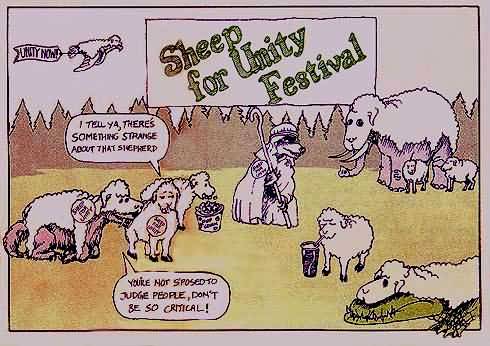
Unity - Man's WayThere's only one problem with that kind of thinking--isn't the Bible all true? How can we just find the lowest common denominator to which all Christians can agree to, and label the rest of God's Word "unessential for unity"? In his book, Today's Gospel-Authentic or Synthetic?, Walter Chantry looks into the reasons for the failure of modern evangelism and foreign missions. In the introduction Mr. Chantry writes: "Having accepted the theory that unity is all-important for world evangelism, both the Church and the individual must lower their estimate of the value of truth. In a large congress on evangelism we could not insist on a truth of God's Word that would offend any brother evangelical. After all, unity (among Christians) is more essential than doctrinal preciseness." "It is for just this reason that the mission boards are hesitant to answer the question, "What is the Gospel?" Thoroughly to answer that would destroy the mission society, which is a federation of churches who have differing answers to that question. To adopt the position of one church would be to lose the support of five others. The whole system built on unity and generality would crumble." Unity - God's Way --- Jesus' Prayer In John 17How are the Father and Son one? In every way! They have no doctrinal disputes, they have no differing theologies, they do not argue over the rapture, they completely agree ... on everything! But you might ask, "How can every Christian agree on doctrine? If we wait for that, we'll never have unity!" You're missing the point. It's not knowing "doctrine" that's important, it's knowing God. Only through entering into an intimate, personal relationship with the living God and leaving behind the doctrines and theologies created by men and church-tradition, can we ever hope to find the unity Jesus prayed for: "I in them, and Thou in Me, that they may be made perfect in one...Father, I will that they also, whom Thou hast given Me, be with Me where I am, that they may behold My glory..." (John 17:23-24). What does the word "theology" mean anyway? It means the study of God." Today, theological students do not study God, they study about God. At best, they study the writings of men who themselves have studied God. Why, they really ought to change the word theology to theology-ology or "the study of the study of God"! True And False DivisionNow the Bible does warn us about those who would enter into our midst and cause divisions and factions (Matt. 12:25; Rom. 16:17; I Tim. 6:3-5; II Tim. 2:14; II John 10). And yes, it has always been the devil's strategy to "divide and conquer." But these divisions are obviously based on error, lies, and usually come from bitter and evil motives (Titus 3:10). Division that comes from the proclaiming of the truth will usually include some intense reaction and opposition, but it will also produce good fruit and the advancement of God's Kingdom (not to mention the conversion of souls). What Bible story is there, Old Testament or New, where the doing of righteousness or the preaching of the Gospel does not divide men and separate them into two very distinct categories: those who are willing to turn and obey God, and those who actually turn on the messenger, because he violently disturbs their false (and usually "religious") peace? And today, when there are so many who are professing religion, is it any wonder that some of the deepest truths in the Bible--repentance, faith, holiness, etc--are also some of the greatest objects of debate and division in the Church. What The Scriptures SayYet there are scriptural commands to defend the truth. "Study to show thyself approved... always being ready to make a defense to everyone who asks you to give an account for the hope that is in you, yet with gentleness and reverence" (II Tim. 2:15; I Pet. 3:15). There are times when we cannot just "be quiet" and let differences go unchallenged, especially when these "differences" are major and dangerous errors that can threaten the faith of those who are weaker and innocently uninformed. The whole book of Galatians was written by Paul to counteract some very heretical teachings that had crept into the Church. Paul writes, I am amazed that you are so quickly deserting Him who called you by the grace of Christ, for a different gospel...there are some who are disturbing you, and want to distort the Gospel...you foolish Galatians, who has bewitched you...? Are you so foolish? Having begun by the Spirit, are you now being perfected by the flesh?...You have been severed from Christ, you who are seeking to be justified by law; you have fallen from grace" (Gal. 1:6-7, 3:1,3, 5:4). Them are fightin' words! Don't you think Paul was accused of causing division for such a strong rebuke? Yet that's just it... he was trying to! Paul was drawing a very clear line and seemed to be saying, "Those who believe they are saved by the Law, do not belong to Christ!" And later Peter, in his second epistle, backs Paul up by warning the Church about people misinterpreting some of Paul's writings "... in which are some things hard to understand, which the untaught and unstable distort, as they do also the rest of the Scriptures, to their own destruction" (II Pet. 3:16). There has always been a need in God's Church to strongly divide between truth and false teaching. What God Really Wants"And I have other sheep, which are not of this fold; I must bring them also, and they shall hear My voice; and they shall become one flock with one Shepherd--John 10:16 |