 |
of Jacob Boehme |
 |

|
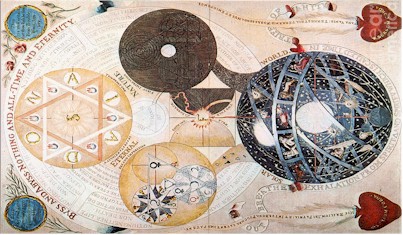
The Three Principles of the Divine Essence ---- According to Jacob Boehme, the Ungrund (literally "unground" or "groundless abyss") is the primal, eternal, undifferentiated divine essence --- the absolute "Nothing" (Nichts) that is simultaneously the potential for "All" (Alles). It is not a being, place, or substance with qualities, form, time, or locality; it is pure, free, unoriginated Will in perfect stillness and mystery, beyond light or darkness, love or wrath. The Ungrund is the "beginning before the beginning," the groundless ground in which even God (as self-revealed) has no "ground" until differentiation occurs. Boehme insists it is not pantheistic chaos but the free, paradoxical source from which the divine self-revelation eternally arises. The differentiation of the Ungrund into the Trinity is not a temporal event or creation ex nihilo in the usual sense, but an eternal, immanent theogony --- a "birth of God" within the divine essence itself. This process is driven by the Ungrund's inherent Will turning toward self-knowledge and self-manifestation. Boehme describes this in his major work The Three Principles of the Divine Essence (1619) and throughout his writings (especially Aurora, Mysterium Magnum, and The Theosophic Points) as unfolding through three principles (Prinzipien), which are simultaneously metaphysical forces or "worlds" that structure the divine being. These three principles are not three separate gods but the one eternal divine essence in threefold dynamic operation. They "ground" the three Persons of the Trinity (Father, Son, Holy Spirit) while remaining one in power and substance. The Ungrund itself remains the abyssal unity "behind" or "in" them, generating a "ground" (Grund) within itself through their interplay. Boehme's own concise formulation (from Three Principles, ch. VII) makes this explicit: "The source of the Darkness is the first Principle, and the virtue or power of the Light is the second Principle, and the Out-birth generated out of the Darkness by the virtue of the Light, is the third Principle; and that is not called God: God is only the Light, and the virtue of the Light, and that which goes forth out of the Light is the Holy Ghost." He illustrates this with the human analogy: the soul (Father), the light shining in the soul (Son), and the mind/proceeding virtue that governs the body (Holy Ghost). The three principles are co-eternal, each the cause of the birth of the others in a circular, living process ("each is the cause of the birth of the other"). They exist in "threefoldness in the unground" and generate the manifested divine ground. Here is the detailed elaboration of the three principles/forces: 1. The First Principle: The Dark Principle (Dark World, Wrath/Fire, "Nature-Will") This is the foundational force of desire, contraction, and primal darkness --- the "source of the Darkness." It corresponds primarily to God the Father as the whole divine power, the eternal, unoriginated Will that draws all things from itself. In the Ungrund, the free Will first "awakens" as a longing or hunger for self-revelation; this produces an inward-turning, astringent force (often called "Salt" in Boehme's alchemical language: contraction, self-concentration, dryness, melancholy, the power of death). This generates opposition and motion ("Mercury": bitterness, expansion, the restless drive), leading to rotation and torment ("Sulfur": the anguishing wheel of life, the turning that produces anguish). These internal dynamics (sometimes described as three archetypal forces --- contraction, expansion, rotation --- forming a "wheel of anguish") create unbearable tension in the dark principle. This tension ignites a "lightning flash" or central fire --- the "birth-pangs" of the divine. The dark principle is not evil in God (though it becomes the root of wrath, hell, and the possibility of evil in creatures who turn away from light); it is the necessary fiery ground of all power, knowledge, and manifestation. Without it, there would be no differentiation from the Ungrund. Boehme calls this the "dark world" (Qualities 1-3 of his seven source-spirits or qualities, subsumed here). 2. The Second Principle: The Light Principle (Light World, Love) From the flash of the dark fire emerges the light, love, and delight --- the "virtue or power of the Light." This is the counter-force that "tinctures" (spiritually penetrates and transfigures) the darkness. It corresponds to God the Son, the eternal Heart or Word of the Father, generated continually from eternity. The Son is the light that shines back into the Father, making the dark power joyful, visible, and harmonious. The dark forces are transmuted: contraction becomes vital "water" or meekness, expansion becomes harmonious "sound," rotation becomes integrating essence. Boehme emphasizes: "God is only the Light, and the virtue of the Light." The light principle nullifies the mere wrath of the dark and births eternal joy. It is the "Heart" in which the Father beholds Himself. Without this second principle, the dark would remain barren anguish; with it, the divine becomes self-conscious love. This is the "light world" (Qualities 5-7 in the sevenfold scheme). 3. The Third Principle: The Out-Birth or Manifest Principle (Visible/Outward World, the Proceeding Life) This is the out-birth or issue generated when the light virtue works upon the darkness --- the "Out-birth generated out of the Darkness by the virtue of the Light." It corresponds to the Holy Spirit, "that which goes forth out of the Light," the moving, living, proceeding spirit. It is the principle of manifestation, the kingdom or body of God, the eternal "out-breathing" that makes the inner divine life visible and active. In the divine realm, this is reflected as Sophia (Wisdom), the uncreated Heaven or Kingdom of Beauty in which the Trinity's glory is imaged. In creation, it becomes the visible, elemental world (the mixed realm of light and darkness). The third principle is "not called God" in the same sense as the light, yet it is essential: it is the spirit-world or outward expression where the Holy Ghost operates as the unifying, animating force. It completes the Trinity by allowing the divine fulness to stream forth and return in reflected glory. Boehme subsumes the central "fire" quality (the turning-point between dark and light) here as well in some groupings, making the third principle the realm of Satan/Christ, nature, and the visible order. How These Three Differentiate the Ungrund into the Trinity The process is not sequential in time, but eternal and reciprocal: The Ungrund's free Will awakens desire ** dark principle (Father, fire of wrath/power). The Trinity is thus one essence in three centers of power: the Father as the source of all power, the Son as the Heart/light, the Holy Spirit as the proceeding life. Each Person is fully God; together they form the living, "triumphing, springing, moveable being" of the Godhead. The Ungrund remains the abyssal freedom "in" which this threefold spirit dwells and from which it eternally generates its own ground. Boehme stresses that this differentiation is necessary for divine self-awareness and joy: without the dark/light tension and its resolution in the proceeding spirit, the Ungrund would remain an empty, will-less abyss. The three principles/forces are therefore the eternal mechanism by which the Godhead becomes manifest to itself while remaining one. This same threefold structure is mirrored micro-cosmically in the human soul and macro-cosmically in creation (and its fall/redemption). In summary, the three principles (dark/desire, light/love, out-birth/proceeding) are the living forces that eternally differentiate the Ungrund into the dynamic, self-revealing Trinity --- Father (dark power), Son (light heart), Holy Spirit (proceeding spirit) --- without ever dividing the one divine essence. This is Boehme's profoundly original theosophical vision of the Christian Trinity as an eternal, alchemical-mystical process of birth, opposition, and harmonious out-flowing. |
|
The Seven Qualities ---- (also called seven source-spirits, fountain-spirits, properties, or forms of eternal nature) are described by Jacob Boehme as being the fundamental, dynamic energies or "qualifying" forces through which the divine essence --- emerging from the Ungrund --- manifests and structures itself. They are not static attributes but living, interdependent processes that generate, permeate, and transform one another in an eternal, wheel-like motion. Boehme often compares them to a rotating wheel with seven spokes or a rainbow of colors, where each quality interpenetrates the others without separation. These seven qualities operate across all levels of reality: in the divine (eternal nature), in the three principles (dark, light, and outward/mixed worlds), in creation, in humanity, and even in the fallen or redeemed states. They explain how undifferentiated potential (the Ungrund) differentiates into self-aware, joyful divine life while providing the structural basis for opposition (wrath vs. love), manifestation, and redemption. Boehme frequently links them to alchemical concepts (salt, mercury, sulfur) and planetary symbols, but they remain primarily spiritual-metaphysical. Overall Structure and Interrelation The seven qualities form a cyclical, generative process: Qualities 1 to 3 dominate the dark principle (first principle: wrath, fire, contraction, the "wheel of anguish" or source of darkness and potential evil).
The first and seventh, second and sixth, third and fifth are often paired as "one" in their respective principles, while the fourth marks the division between dark and light. They are co-eternal and simultaneous ("each is the first, middle, and last"), yet Boehme describes them sequentially for human understanding, like spokes in a wheel that generate one another in perpetual "birth" or "geniture." In the light world, they produce joy and paradise; in the dark world, they produce anguish and hellish wrath. In the third principle (visible creation), they mix good and evil. Boehme associates them with: Alchemical tria prima: 1 -- Salt (astringency/desire), 2 -- involving Mercury (motion/bitterness) and 3 -- Sulfur (anguish/fire). Detailed Explanation of Each Quality First Quality: Desire / Astringency / Harshness / Attraction (Salt; often linked to Saturn) This is the primal contraction or inward-drawing force --- the "desire" or hunger of the Ungrund's Will to manifest itself. It creates darkness, hardness, coldness, dryness, and corporeity (the beginning of "body" or substantiality). Boehme calls it the "harsh, astringent quality" that draws all into itself, producing a dark, melancholic, self-concentrating power. Without this, there would be no differentiation or "ground." In the dark principle, it leads to rigidity and the root of wrath; when tinctured by light, it becomes vital "water" or meek foundation. It corresponds especially to God the Father as the source of all power. Second Quality: Motion / Bitterness / Sting / Sweetness (Mercury; often Jupiter or Mercury) Arising from the first quality's contraction, this is the expansive, restless motion or "sting" that flees outward. It introduces perception, activity, and a bitter-sweet tension --- the drive to escape rigidity. Boehme describes it as the "bitter quality" or "mercurial" spirit of mobility, fleeing, and subtle perception. It creates the first dynamic opposition: attraction vs. repulsion. In darkness, it fuels endless, tormenting movement; in light, it becomes harmonious "sweetness" or vital flow. Linked to the Son in its spiritual aspect (power/virtue). Third Quality: Anguish / Sulfur / Whirling / Wheel of Life (Sulfur; often Mars) The interaction (friction) of the first two produces unbearable anguish --- a rotating "wheel" or "wheel of anguish" where contraction and expansion clash in endless torment. This is the "sulfurous" quality: bitterness intensified into suffering, oscillation, and the "wandering" sensation of life in tension. It is the source of the "fountain of anger" and hell in the dark principle, yet it also births the possibility of breakthrough. The three together (1 to 3) form the dark world's foundational torment. Linked to the Holy Spirit in its fiery aspect. Fourth Quality: Fire / Lightning Flash / Schreck (Shock) or Flagrat (often the Sun) At the height of anguish, a sudden flash or "lightning" ignites --- the central fire or "salnitric fire-crack." This is the turning point: the dark fire can remain wrathful (producing hell) or be transmuted into the light of love. Boehme calls it the "birth-pangs" or the moment where the wheel breaks open. It stands as the "balance" or dividing mark between the dark and light principles. In the light world, it becomes the triumphant, life-giving fire that kindles joy. This quality is crucial in Boehme's theogony and in human regeneration (the "new birth"). Fifth Quality: Love / Light / Meekness / Delight (often Venus) From the flash arises the true light and love --- the counter-force that tames the dark qualities. Contraction becomes gentle substance ("water"), motion becomes harmonious flow, and anguish dissolves into joy and meekness. This is the "lovely, celestial" quality: the beginning of substantiality in the light world, the "tincture" that penetrates and transfigures everything. It corresponds strongly to the Son (Heart of God) and produces the "kingdom of joy." Without it, the first three remain barren torment. Sixth Quality: Sound / Understanding / Intelligent Life / Word (Mercury/Jupiter) The light and love now express themselves as sound, voice, or articulate spirit --- the "verbum fiat" (let there be) or living word. This is conscious, intelligent life: the ringing, distinguishing, communicative power where all qualities "speak" or manifest their essence clearly. It brings differentiation with harmony, understanding, and the proceeding life of the Spirit. In the light world, it is the substantial power and virtue of the Son. Seventh Quality: Essential Substance / Body / Corporeality / Wisdom (Luna/Moon; Essential Wisdom or Body of God) The culmination: the essential body or substantial manifestation in which all previous qualities find concrete, corporeal expression. It is the "house" or "paradise" where the six others dwell substantially --- like the soul in the body. Boehme calls it "Essential Wisdom" (Sophia-like), the budding, fruitful kingdom or the full "figure" of divine glory. In the light world, it is the beautiful, manifested body of God (heaven/paradise); in the dark, a hardened, wrathful corporeity. It completes the cycle and refers back to the Father as substantial desire. This is the "out-birth" made perfect in the light. Relation to the Three Principles and the Trinity In the first (or dark principle - Father/wrath): Qualities 1 to 4 predominate as anguish and fire. The seven qualities thus "ground" the Trinity's dynamic life: the Father's desiring power (1/7), the Son's light and virtue (2/6), the Spirit's fiery proceeding and substantiality (3/5), with the central fire as the heart. They mirror the process by which the Ungrund eternally births self-revealing divine nature. Significance Boehme's seven qualities provide a profound theosophical psychology and cosmology: every being, process, or state bears a "signature" according to which quality predominates. Human regeneration involves turning from the dark wheel of anguish (qualities 1 to 3 in self-will) through the flash of faith to the light world of love and wisdom. They also explain evil (perversion of these forces in separation from light) and redemption (their harmonious tincturing by divine love). This framework influenced later thinkers in mysticism, alchemy, Romanticism (e.g., Blake), and esoteric traditions, offering a dynamic alternative to static scholastic theology. Boehme repeatedly stresses that these are not abstract but living, experiential realities knowable through inner illumination. |
|
Click HERE to read a summary of the major points from Basarab Nicolescu's book, "Science, Meaning, and Evolution: The Cosmology of Jacob Böhme" Click HERE to read a summary of the major points regarding The Christology of Jacob Böhme" Click HERE to read a summary of the major points regarding "A Comparison Between Jacob Boehme's Christology and Modern Christian Views" Click HERE to read a summary of the major points regarding "A "Living Foundation" ** Christian Theology vs. Jacob Boehme" Click HERE to access a collection of videos and various writings of Jacob Boehme Click HERE to read: Chapter Six, "Jacob Boehme and the Evolution of Man", Lucifer's Action: Contemporary Resonances - |


